optional · CSS study notes
III.3 Policy Analysis
🧠
Key points — 30-second recap
- Policy analysis = the systematic use of reasoning and evidence to understand a public problem and compare options before (and after) a decision.
- Steps: define problem → set criteria → identify options → forecast effects → compare → recommend → monitor.
- Bardach's Eightfold Path: define · assemble evidence · construct alternatives · select criteria · project outcomes · confront trade-offs · decide · tell your story.
- Criteria: effectiveness · efficiency · equity · feasibility (political, administrative, legal) · sustainability.
- Tools: cost–benefit analysis, cost-effectiveness, multi-criteria analysis, RIA, SWOT, stakeholder analysis, pilots.
- Models of decision: rational (Simon's limits), incremental (Lindblom), mixed scanning (Etzioni); Dye: policy is "whatever governments choose to do or not to do".
- In simple words: doing the homework — weighing options with facts before choosing.
Foundation: Public Policy and the Six-Stage Policy Cycle
📖 Exam-ready definition
- Thomas R. Dye: “Whatever governments choose to do or not to do.” This defines public policy; examining why government acts and what difference it makes belongs to policy analysis.
- Policy making: the process through which public problems become priorities, alternatives are developed, authorised choices are made, resources are committed and results are reviewed.
- Welfare and resource allocation:
- limited public resources require choices between competing needs; good policy balances efficiency with equity, particularly the needs of vulnerable groups.
- Use this as an analytical principle, not an attributed Benazir Bhutto quotation: the supplied wording could not be verified against a primary source.
- Definition reference: Dye's formulation is discussed in Paul Cairney, Understanding Public Policy.
🗣️ In simple words
- It is government's plan of action on an issue — and inaction is also a policy.
- 🇵🇰 Example: choosing a school-support programme and deliberately retaining an existing tax exemption are illustrative policy choices; Pakistan's agricultural-income taxation must be described using the applicable provincial law.
The policy cycle (master framework)
Diagram: Problem identification → Agenda setting → Formulation → Adoption → Implementation → Evaluation ↺ revised problem and priorities.
The familiar five-stage A-F-A-I-E framework includes problem identification within agenda setting. Showing identification separately gives six stages. Either convention is acceptable when explained; evaluation must remain part of the cycle.
| Stage | What happens | Key question / output |
|---|---|---|
| 1. Problem identification | Diagnose the issue before selecting a solution | Evidence-based problem statement and baseline |
| 2. Agenda setting | The issue gains serious government attention amid competing priorities | A problem government is prepared to address |
| 3. Formulation | Develop and compare options, including doing the minimum | Costed, feasible alternatives and recommended instrument |
| 4. Adoption / legitimation | The competent authority authorises the choice | Decision and required legal authority; a new law is needed only where existing powers are insufficient |
| 5. Implementation | Translate authority into action: budget, staff, responsibilities, procedures and services | Delivery arrangements and measurable outputs; use existing bodies or create new ones only where justified |
| 6. Evaluation and feedback | Judge intended and unintended results, equity and value for money | Evidence to continue, modify, expand or terminate the intervention |
Stage 1. Problem identification: diagnose the need
- Nature and scale: define the gap between current and desired conditions; separate symptoms from causes.
- History: when did it emerge, how has it changed, and what previous interventions achieved.
- Affected population: who, where and how severely; disaggregate by income, gender, disability and location where relevant.
- Public awareness: examine complaints, media attention and consultation; visibility is not the same as severity.
- Existing policy: identify legal coverage, delivery gaps and unintended incentives before proposing another scheme.
- Evidence and baseline: combine administrative data, research and affected people's experience; state uncertainty.
- Root-cause example: low girls' attendance may reflect unsafe travel, costs or missing teachers. Building classrooms alone may leave the binding constraint untouched.
Stage 2. Agenda setting: secure attention
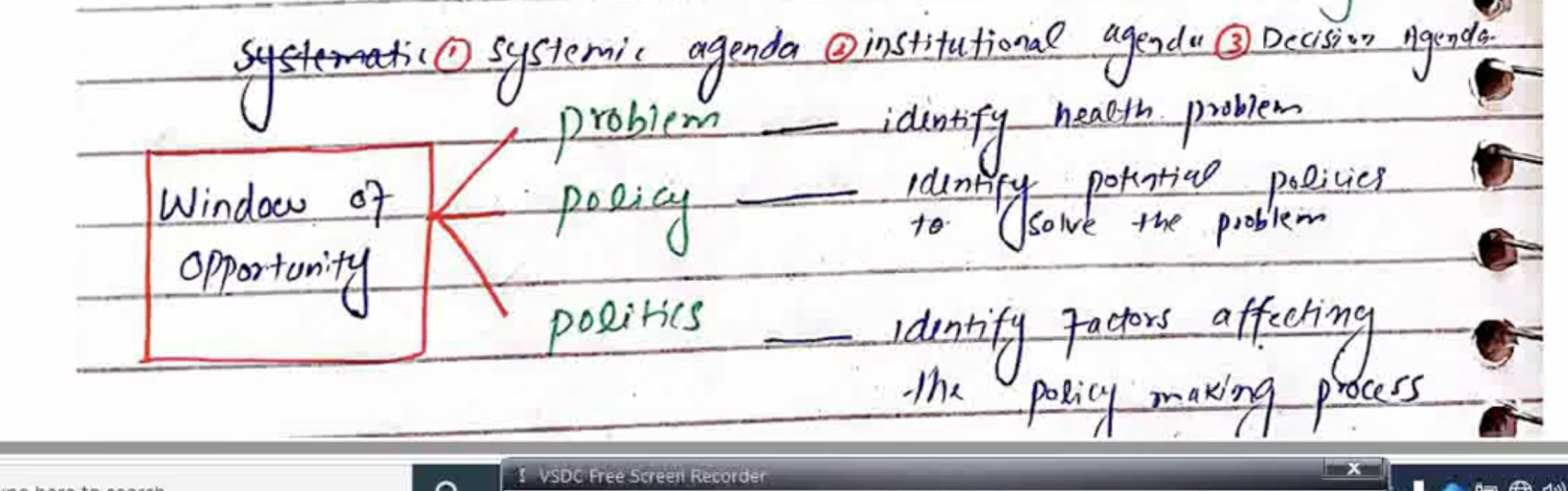
- Problem stream: indicators, crises and feedback draw attention to a condition.
- Policy stream: specialists develop proposals that appear technically feasible and acceptable.
- Politics stream: public mood, organised interests and political changes affect support.
- Policy entrepreneurs connect a recognised problem, a viable proposal and political support when a window opens. A window creates an opportunity, not a guarantee of adoption.
- Detailed model comparisons appear in section 4 below. See also the World Bank discussion of Kingdon's streams.
Agenda levels: from public concern to a decision
| Agenda | Meaning | Illustrative example: unsafe drinking water |
|---|---|---|
| Systemic / public | Issues widely regarded as deserving public attention and legitimate government action | Citizens and the media demand safer water |
| Institutional / governmental | Issues receiving active, serious consideration by public authorities | The responsible department formally examines water-quality measures |
| Decision | The narrower set of issues on which authorities are preparing to make an active choice | A specific treatment or testing proposal is placed before the competent authority for a decision |
- Memory cue: public concern → official consideration → decision-ready issue.
- Attribution: Cobb and Elder distinguish systemic and institutional agendas; Kingdon distinguishes the governmental agenda from its narrower decision agenda. Agenda-setting research overview.
- Important: reaching the decision agenda does not mean approval. The proposal may be adopted, rejected or deferred.
- Not an automatic ladder: limited attention, political opposition or weak proposals can stop movement; some issues originate inside government without broad public debate.
Agenda levels versus Kingdon's streams
- Levels describe how far an issue has reached: public attention, official consideration or an impending choice.
- Streams describe what may come together to enable change: a recognised problem, a viable policy proposal and political support.
- CSS recall: explain the three levels using one example, then show how a policy entrepreneur can couple the streams when a window opens.
Stage 3. Policy formulation: design the response
Meaning: develop and compare possible responses before the competent authority adopts a policy.
Formulation in five steps
| Formulation step | What to do | School-attendance example |
|---|---|---|
| 1. Situation diagnosis | Refine causes, scale and evidence | Check whether hunger or travel cost is the main barrier |
| 2. Option generation | Develop alternatives, including a baseline | Meals, transport assistance, household support or improved existing services |
| 3. Feasibility and impact assessment | Examine costs, legal authority, capacity, equity and acceptance | Can schools safely store food, manage providers and sustain recurring expenditure? |
| 4. Consultation and negotiation | Hear officials, interests and citizens; make trade-offs explicit | Discuss dietary needs with families and operational burdens with teachers |
| 5. Drafting | Specify the proposal, reasons, responsibilities and measures | Draft eligibility rules, funding arrangements, quality checks and attendance indicators |
Output: a reasoned proposal ready for consideration. Formal authorisation belongs to adoption, not merely drafting.
Stage numbering: formulation is third in this six-stage diagram. Other frameworks combine stages, so numbering varies. The WHO workshop groups the process into four broad stages.
Who participates?
- Government officials: departments, analysts and technical experts draft and assess proposals.
- Interest groups: professional bodies, businesses, unions and civil-society organisations present needs and preferences.
- Individual citizens: contribute lived experience through consultation and feedback.
- Why consultation matters: it reveals delivery barriers and competing interests; participation does not give every participant formal decision-making power.
What should formulation produce?
| Element | Question the draft must answer |
|---|---|
| Clear goals | What change is intended, for whom and by when? |
| Options and strategy | Which instruments and actions could achieve it? |
| Resources and responsibility | What will it cost, and who will deliver it? |
| Obstacles and risks | What legal, political, financial or administrative barriers may arise? |
| Measures of effects | What baseline, indicators and evaluation arrangements will show results? |
Two approaches to choosing options
- Rational-comprehensive: compare alternatives systematically against stated criteria; consider effectiveness, efficiency, equity and feasibility.
- Incrementalism: make negotiated, gradual adjustments to existing policy; this can be feasible but may preserve weaknesses.
Other explanatory frameworks
- ACF: shared beliefs, coalitions and learning help explain policy stability and change.
- Garbage Can Model: problems, solutions, participants and choice opportunities connect under organisational ambiguity.
- These frameworks explain different features of policy making; they are not compulsory drafting steps or a simple “new policy versus reused policy” choice.
Illustration — school attendance: consult families and teachers → compare transport support and household assistance → define the target and budget → anticipate delivery risks → specify attendance and equity indicators.
Recall: People → Goals → Options → Resources → Risks → Results.
Stage 4. Policy adoption: authorise the choice
- Meaning: the competent authority formally accepts a policy option.
- Tasks: examine the proposal, resolve outstanding objections and obtain the required executive or legislative authorisation.
- Output: an authorised decision and the necessary legal basis.
- Distinction: preparing a draft is formulation; accepting it is adoption. Not every policy needs a new Act.
- Example: approval of a school-transport scheme under the applicable authority.
- Risk: political approval without a realistic funding route can leave the decision undeliverable.
Stage 5. Policy implementation: organise delivery
- Meaning: turn the adopted policy into programmes, services and action.
- Plan: assign tasks, responsible agencies, deadlines and coordination arrangements.
- Resource: arrange funding, staff, training, procurement and operational guidance.
- Deliver: use existing institutions where suitable; establish new arrangements only where justified.
- Monitor: track milestones and complaints; identify bottlenecks early.
- Example: organise transport routes, providers, payments and safety checks.
- Risk: an implementation gap arises when intended delivery differs from what happens.
- Detailed approaches and techniques: III.4 Policy Implementation and the Implementation Gap.
Stage 6. Policy evaluation: judge and learn
- Meaning: assess design, delivery and results against explicit criteria.
- Ask: were goals achieved, who benefited or was excluded, and were resources used well?
- Check: unintended effects, sustainability and the credibility of causal claims.
- Decide: continue, modify, expand or terminate; explain the evidence supporting the choice.
- Example: assess attendance, safety, access and cost; a before–after improvement alone does not prove causation.
- Feedback: revise the diagnosis, redesign the instrument or repair delivery, depending on the failure found.
- Methods and comparisons: III.5 Program Evaluation — Policy and Programme Evaluation.
📝 Extra notes
- Policy vs law vs programme vs plan: policy = intent and direction; law = binding legal rule; programme = organised activities to deliver a policy; plan = timed steps and resources.
- Models of policy making: rationalism, incrementalism, group and elite models, systems, Multiple Streams, ACF and the Garbage Can Model are compared in section 4 below.
- Cycle critique: real policy-making is messy and overlapping, not a neat sequence.
🧪 Worked Example — All Six Policy Stages
Hypothetical school-attendance policy: use the same example through the stages, rather than switching cases in every paragraph.
| Stage | What happens in practice | What the example demonstrates |
|---|---|---|
| Identification | Records and family interviews reveal absence associated with hunger and travel barriers | Diagnose causes before choosing a scheme |
| Agenda setting | Evidence and public concern secure official attention; a viable proposal and political backing create an opportunity | Attention and support affect priorities |
| Formulation | Officials consult families, compare meals and transport support, cost options and draft delivery arrangements | Design and assess alternatives |
| Adoption | The competent authority formally authorises the selected proposal through the applicable route | A draft becomes an authorised choice |
| Implementation | The responsible department arranges funding, staff or providers, schedules and safeguards | Resources and responsibilities produce delivery |
| Evaluation | Assess attendance, inclusion, costs and unintended effects; revise or discontinue ineffective elements | Feedback changes future decisions |
Do not confuse: drafting a scheme with approving it, spending funds with delivering services, or delivering services with achieving outcomes.
🤝 Social policy (2017 Q8c)
Meaning: public policy aimed at human welfare: protection from social risks and wider access to opportunity.
What it addresses
- Risks: poverty, illness, old age and unemployment.
- Services: health, education, housing and social protection.
What it aims to achieve
- Reduce poverty and inequality.
- Build human capital.
- Promote inclusion and social cohesion.
- Protect vulnerable groups.
Main instruments
| Instrument | Meaning / example |
|---|---|
| Universal services | Schools and clinics |
| Social assistance | Cash transfers, such as BISP |
| Social insurance | Pensions and employee schemes |
| Subsidies and transfers | Including zakat-based assistance |
| Labour protection | Protection through employment-related measures |
Pakistan application
- Examples: BISP / Ehsaas-type transfers, Zakat and Bait-ul-Mal; verify current programme names before quoting.
- After the 18th Amendment, health and education are largely provincial subjects.
Main challenges
- Low spending on health and education.
- Targeting errors and leakage.
- Fragmented federal and provincial programmes.
- Weak data and delivery capacity.
Exam conclusion: social policy turns growth into human development. Judge it by who is reached, how fairly, and with what result.
Types and instruments of policy
- Lowi's types (by effect)
- Distributive — gives particular benefits (subsidy to farmers);
- Redistributive — shifts resources between groups (progressive tax, BISP);
- Regulatory — sets rules and standards (speed limits, drug pricing);
- Constituent — changes institutions (new ministry, devolution).
- Instruments (how government acts) — spending, taxation, regulation, information campaigns, direct provision.
- Example — reducing road deaths needs safer roads, speed rules, public awareness and emergency care together; explain why the mix fits the problem.
- Agenda point — a big social problem is not automatically a government priority; attention depends on evidence, pressure, politics and a ready solution (Kingdon's policy window).
- Inaction — deliberate inaction is policy, but not every failure is a considered choice.
- Cycle caution — the cycle is an organising device, not a neat real-life sequence.
- Practice outline — problem → actors and agenda → type and instruments → authorisation → implementation capacity → evaluation.
✅ How to score
- Definition (Dye) → cycle diagram → explain the mechanism at each stage → follow one Pakistan illustration through the cycle → assess design, delivery and evaluation gaps → targeted reforms.
- Analytical conclusion: sound policy requires the right diagnosis, legitimate choices, funded delivery and credible feedback; success at one stage cannot compensate for failure at another.
⚠️ Common mistakes
- Treating policy as only written documents (inaction counts).
- Presenting the cycle as strictly linear.
❓ Active recall
- Explain the five-stage cycle and its six-stage version with separate problem identification; apply each stage to one Pakistan example.
- Name three models of policy-making with one line each.
1. Meaning, Purpose and Scope
Definition
- Policy analysis: systematic study of a public problem and comparison of alternatives, using evidence and explicit criteria to support a recommendation.
- Dunn: an applied social science using multiple methods to produce policy-relevant information.
- Dye: investigate what governments do, why they do it and what difference it makes.
- Harold D. Lasswell: a founding figure, commonly called the father of policy sciences. His contribution connects interdisciplinary knowledge with public problem-solving. Cambridge study of the origins of policy sciences.
Purpose: support a defensible choice
- Identify the real problem rather than its most visible symptom.
- Compare benefits, costs, risks and distributional effects.
- Recommend an option suited to social, political, economic, legal and administrative conditions.
- Explain why it is preferable and what conditions are needed for success.
Choice and evidence work together: analysis is decision-oriented, but it does not disregard truth. Credible facts and causal reasoning inform choices; values determine how competing objectives are weighed. The “best” option is conditional on evidence, criteria and constraints.
When does analysis happen?
- Before a decision: diagnose needs, generate options and appraise likely consequences.
- During implementation: investigate delivery problems and assess adjustments.
- After implementation: examine results and inform continuation, redesign or termination.
- Correction: analysis is not confined to the interval after a policy is formed and before implementation. It also helps formulate the policy itself. Government Analysis Function guidance.
Types: distinguish timing from purpose
| Basis | Type | Main question | Example |
|---|---|---|---|
| Timing | Prospective / ex-ante | What is likely to happen under each option? | Forecast effects of a proposed congestion charge |
| Timing | Retrospective / ex-post | What happened, why, and with what effects? | Assess results of an existing transport policy |
| Purpose | Descriptive / explanatory — analysis of policy | How did the policy emerge and operate? | Explain changes in wheat procurement policy |
| Purpose | Prescriptive / normative — analysis for policy | What should government do? | Recommend targeted support or reform of an existing subsidy |
- Retrospective and prescriptive are not opposites: one concerns timing; the other concerns purpose.
- Prescriptive analysis can recommend a new policy, an amendment, continuation or termination—not only a policy built from scratch.
- Descriptive analysis may examine institutions, groups, procedures and outcomes.
- Example of overlap: retrospective evidence about a subsidy can support a prescriptive recommendation to redesign it.
- All can use qualitative and quantitative evidence. Prospective work is forward-looking; policy analysis as a whole also examines past experience.
Who contributes?
| Contributor | Contribution | What to scrutinise |
|---|---|---|
| Policy analysts | Structure the problem; compare options and evidence | Methods, assumptions and uncertainty |
| Think tanks / researchers | Research, independent proposals and specialist knowledge | Evidence quality, funding and viewpoint |
| Advisers | Translate findings into recommendations suited to decision-makers | Whether advice fairly presents trade-offs |
| Interest groups | Sector knowledge, preferences and likely reactions | Representation, incentives and selective claims |
| Citizens / service users | Lived experience and delivery barriers | Whether consultation includes less powerful groups |
Exam distinction: these contributors inform and influence analysis; formal decisions rest with the competent public authority.
2. The Policy-Analysis Process — Learn Through One Case
Running illustration: a provincial education department wants to improve attendance in underserved schools. This is a hypothetical case, not a claim about a specific programme.
Step 1. Define and structure the problem
- Do: establish the scale, affected groups, causes and baseline.
- Example: examine attendance registers and interview families. Test whether absence reflects hunger, transport costs, unsafe travel or teacher absence.
- Write: “The analyst must distinguish symptoms from causes; low attendance does not by itself establish that school meals are the appropriate remedy.”
Step 2. Set evaluation criteria
- Do: specify how alternatives will be judged before selecting one.
- Example: compare attendance gains, cost per additional regular attendee, access for disadvantaged pupils, affordability and delivery capacity.
- Write: “Explicit criteria prevent the cheapest or most politically attractive option from being mistaken for the best policy.”
Step 3. Identify alternatives
- Do: consider several instruments and a do-minimum baseline.
- Example: compare school meals, transport assistance, targeted household support and improvements to existing services. Consider combinations where causes overlap.
- Write: “Alternatives should respond to the diagnosed causes rather than merely reproduce a preferred scheme.”
Step 4. Forecast outcomes
- Do: estimate likely benefits, costs, risks and distributional effects.
- Example: use existing research, local data and a pilot to estimate attendance gains and recurring costs. Test higher food prices or lower participation.
- Write: “Forecasts should state assumptions and uncertainty; projected benefits are not proven results.”
Step 5. Compare options and confront trade-offs
- Do: compare the alternatives against the same criteria.
- Example: meals may address hunger, while transport support may better reach distant pupils. The lower-cost option may exclude a particularly vulnerable group.
- Write: “Efficiency must be weighed alongside equity, feasibility and the distribution of benefits.”
Step 6. Recommend an option
- Do: state the preferred choice, supporting reasons, limitations and delivery conditions.
- Example: if evidence identifies hunger as the main barrier, recommend a limited school-meal pilot with a recurrent budget, food-quality checks and clear responsibility.
- Write: “The recommendation is conditional on evidence and capacity, with expansion dependent on demonstrated performance.”
Step 7. Monitor, evaluate and revise
- Do: track delivery, assess results and use findings to change decisions.
- Example: monitor meals served and delivery interruptions; evaluate attendance, nutrition, exclusion and cost. Use a credible comparison to assess attribution.
- Write: “Meal counts measure outputs; improved attendance is an outcome, while attribution requires evidence of what would have happened without the intervention.”
Memory: Problem → Criteria → Options → Forecast → Compare → Recommend → Review.
Bardach's Eightfold Path — The Same Case in Eight Tasks
The seven steps above are a teaching framework. Bardach's named framework has eight tasks; do not attribute the seven-step list to him.
| Task | Practical action in the school-attendance case |
|---|---|
| 1. Define the problem | Specify persistent absence and who is most affected |
| 2. Assemble evidence | Combine attendance records, household interviews and relevant studies |
| 3. Construct alternatives | Compare meals, transport, household support and the baseline |
| 4. Select criteria | Agree on effectiveness, cost, equity and feasibility |
| 5. Project outcomes | Estimate likely attendance gains, costs and risks |
| 6. Confront trade-offs | Explain the tension between low cost and reaching remote pupils |
| 7. Decide | Recommend the option best supported by the evidence and criteria |
| 8. Tell your story | Present a concise brief: problem, evidence, options, recommendation and uncertainties |
Exam distinction: the policy cycle covers the wider governmental process; policy analysis supplies evidence and advice within that process.
3. Tools and Techniques
- Cost–benefit analysis (CBA)
- Method: compare social costs and benefits in monetary terms; discount future values and calculate net present value or a benefit–cost ratio.
- Strength: provides a common basis for judging economic efficiency.
- Limitation: difficult-to-value effects, such as dignity, ecological loss or community ties, may be understated if omitted or poorly valued.
- Safeguard: report unmonetised effects and distributional consequences alongside the monetary result; test sensitive assumptions. Green Book guidance.
- Cost-effectiveness analysis — cost per unit of outcome (per child enrolled, per life saved).
- Multi-criteria analysis (MCA)
- compare options across monetary and non-monetary criteria, such as cost, equity, environmental effects and feasibility.
- Define criteria, score consistently, justify weights and test whether different weights change the ranking.
- Strength: flexible across quantitative and qualitative criteria; explicit scores and weights make trade-offs transparent.
- Limitation: rankings depend on judgements about criteria, scores and weights. Rather than saying it simply “lacks objectivity,” explain where subjectivity enters.
- Safeguard: justify the choices and test alternative weights. Government MCA manual.
- Regulatory Impact Assessment (RIA) — costs and benefits of new rules.
- Stakeholder analysis — winners, losers, power.
- SWOT: assess capability and context
- Strengths: internal advantages, such as skilled staff.
- Weaknesses: internal constraints, such as poor data systems.
- Opportunities: favourable external developments, such as new technology.
- Threats: external risks, such as rising fuel prices.
- Application: define the agency or programme being assessed; connect each finding to an action instead of producing a descriptive list.
- PESTEL / PESTLE: scan the external environment
- Political: government priorities, opposition and stakeholder influence.
- Economic: costs, inflation, incomes and fiscal constraints.
- Social: public acceptance, demographics, equity and behaviour.
- Technological: available systems, capability and digital access.
- Environmental: pollution, climate risks and resource effects.
- Legal: authority, rights, rules and compliance requirements.
- Memory: both spellings contain the same six factors; PESTEL scans external conditions, while SWOT combines internal and external factors.
- Forecasting and scenario analysis
- Purpose: project possible outcomes before implementation, or update expectations during delivery.
- Forecasting: use trends, models or expert estimates to project outcomes under stated assumptions.
- Scenario building: explore several plausible futures using “what if” conditions; scenarios need not be predictions or carry probabilities.
- Illustration: forecast transit demand, then test whether the proposal still works with high fuel prices, low ridership or delayed funding.
- Distinction: forecasting is a technique; economic impact analysis focuses on effects such as jobs, income and output.
- Limit: predictions depend on assumptions and do not prove that a policy caused an observed result.
- Economic impact analysis
- estimates effects on employment, income, output or value added, sometimes including direct, indirect and induced effects.
- State the geographic boundary, baseline and assumptions; account for displacement, leakage and activity that would occur anyway.
- Increased activity is not automatically a net social benefit. Official economic-impact guidance.
- Pilot projects and randomised trials — test before scaling.
- Sensitivity analysis — how results change if assumptions change.
Formulation techniques: connect evidence to choices
The existing CBA, cost-effectiveness, MCA and forecasting tools above support formulation. Use a technique to answer a specific question, not simply to name it.
| Technique | What it helps you do | Illustration / limitation |
|---|---|---|
| Economic forecasting | Project future demand, costs or impacts using trends, scenarios and models | Forecast school enrolment; results depend on assumptions |
| Systems analysis | Examine objectives, alternatives and interactions across the whole service system | Relate transport, teacher availability and attendance rather than treating them separately |
| Operations research | Use quantitative models to allocate scarce resources under constraints | Choose transport routes or staff schedules; numerical optimisation cannot settle every value conflict |
| PPBS — Planning–Programming–Budgeting System | Connect long-range objectives to alternative programmes, multi-year resource implications and annual budgets | Compare programmes for attendance, then translate the chosen programme into funded activities |
- PPBS memory: planning asks what goal?; programming asks which package of activities?; budgeting asks what resources?
- Limit: information demands and analytical capacity can constrain these techniques; technical estimates must be weighed with equity, feasibility and political judgement.
- References: GAO glossary of systems analysis and PPB; Open University: systems analysis in public policy.
4. Models of Policy Making (often asked with analysis)
Read in three groups: choosing alternatives → explaining influence → explaining ambiguity and change.
A. Choosing alternatives
- Rational-comprehensive model
- specify goals and criteria, identify alternatives, forecast consequences and select the option that best meets those criteria.
- Efficiency matters alongside equity and feasibility.
- Strength: systematic comparison.
- Limit: incomplete information, time and conflicting values; Simon's bounded rationality explains why decision-makers often satisfice.
- Incremental model (Lindblom, 1959)
- compare a limited set of small departures from existing policy and adjust through bargaining.
- Strength: feasible under uncertainty and easier to negotiate.
- Limit: can preserve inequity and underreact to a major crisis.
- Incrementalism describes a decision approach; it is not simply any reuse of old material.
- Mixed scanning (Etzioni, 1967) — broad scan, then detailed look at key choices.
B. Explaining influence and authority
- Elite model — policy reflects the preferences of the elite (C. Wright Mills).
- Group model — policy is the balance of group pressures (Truman).
- Institutional model
- policy as the output of government institutions.
- Constitutions and laws assign authority, while courts and administrative rules shape which options are legally possible.
- Institutions can constrain choices as well as confer legitimacy.
- Systems model (Easton)
- inputs (demands, support) → political system → outputs (policies) → feedback.
- This feedback is not merely information gathering: reaction to outcomes can alter demands, political support and subsequent policy.
- Public choice model — self-interested actors (see II.8).
C. Explaining ambiguity and policy change
- Garbage Can Model — Cohen, March and Olsen (1972):
- under ambiguous goals, unclear processes and fluid participation, decisions arise from the coupling of problems, solutions, participants and choice opportunities.
- A ready-made solution can search for a problem.
- It explains organisational choice under ambiguity; it is not a method for recycling existing policies. Original paper.
- Multiple Streams — Kingdon (1984):
- problems, policies and politics can be coupled by policy entrepreneurs when a policy window opens.
- This helps explain agenda change; distinguish its three streams from the Garbage Can Model's four.
- Advocacy Coalition Framework — Sabatier and Jenkins-Smith:
- actors across government and society coordinate around shared policy beliefs within a policy subsystem.
- Competition, policy-oriented learning and external changes help explain policy stability and change over time.
- It applies to changing or maintaining existing policy as well as new initiatives, not only “creating a new policy.” Sabatier's original framework.
Use models to answer different questions: rationalism and incrementalism explain how alternatives are chosen; Multiple Streams explains agenda opportunities; the Garbage Can Model explains ambiguous organisational choices; ACF explains belief-based coalitions and change over time. These are analytical lenses, not mandatory sequential steps.
5. Applying Analytical Tools to the Running Case
The school-attendance case in section 2 supplies the process. Use the tools below to deepen the argument.
| Tool | Practical use | Exam caution |
|---|---|---|
| CBA | Compare discounted social costs and monetisable benefits | Do not omit important unmonetised effects |
| Cost-effectiveness | Compare cost per additional regular attendee | Compare like outcomes, over the same period |
| MCA | Score attendance, equity, safety and feasibility using explained weights | Different weights can change the ranking |
| SWOT | Assess department staff and data strengths / weaknesses; external opportunities / threats | Define the agency or programme being assessed |
| PESTEL | Check political support, food prices, family acceptance, payment systems, environmental risks and legal authority | Connect each factor to an implication for the decision |
| Forecasting | Estimate demand and recurring expenditure | State assumptions and uncertainty |
| Scenarios | Test high food prices, interrupted supplies or low participation | Plausible futures are not established facts |
| Systems analysis | Examine interactions among hunger, transport, teachers and attendance | Avoid solving one bottleneck while ignoring another |
| Operations research | Plan delivery routes under vehicle, time and cost constraints | A mathematically efficient route may still raise equity concerns |
| PPBS | Link the attendance goal to programme alternatives and funding over several years | An approved objective still needs credible annual funding |
Small numerical example — cost-effectiveness
Invented figures for explanation only: assume comparable programmes, the same evaluation period, all relevant costs included and credible estimates of additional regular attendees.
- Option A: Rs 1,000,000 ÷ 100 additional regular attendees = Rs 10,000 each.
- Option B: Rs 1,200,000 ÷ 150 additional regular attendees = Rs 8,000 each.
- Interpretation: B has the lower cost per additional attendee, despite costing more overall.
- Qualification: check affordability, access, delivery capacity and other benefits before recommending B. Cost-effectiveness is one criterion, not the whole decision.
6. Limitations
- Data gaps and poor statistics.
- Political pressure overrides evidence.
- Values conflict (efficiency vs equity) and cannot be settled by numbers.
- Social outcomes are hard to measure.
- Pilot success may not scale.
- Analysts may hide value choices behind "technical" language.
7. 🇵🇰 Policy Analysis in Pakistan
- Where it exists — PC-I and PC-II feasibility appraisal, Planning Commission sections, PIDE research, SDPI, World Bank and ADB appraisals, provincial P&D policy units.
- Weaknesses — few trained analysts in ministries; decisions often political or donor-driven; weak data (late census, poor district statistics); little RIA; reports rarely published.
- Way forward — policy units in each ministry; mandatory RIA for major regulations; open data; partnerships with universities; publish appraisals.
- Example: before launching a health-card scheme, analysts should weigh cost per patient, coverage, fraud risk and fiscal sustainability.
8. Critical Evaluation
- Policy analysis improves decisions but cannot replace democratic choice about values.
- Exam verdict: Policy analysis should inform an authorised decision, not disguise value judgements as technical necessity.
9. 📌 Past Paper Questions — CSS 2015–2026
Subjective questions
- 2025 · Q4 · 20 marks — Define policy analysis and evaluation; explain the analysis process; suggest areas to improve implementation in Pakistan. → 2025 · Q4 · Policy analysis, evaluation and implementation reform (20 marks)
- Use: sections 1–3 here, III.5 for evaluation, III.8 for Pakistan.
- 2017 · Q8(c) · 10 marks — Social policy. → 2017 · Q8c · Social policy (10 marks)
- Use: definition of public policy (Extra · III.0) + analysis criteria (equity).
MCQ practice
- "Public policy is whatever governments choose to do or not to do" — (A) Easton (B) Dye (C) Lasswell (D) None of these → ✅ B. Thomas Dye.
- The Eightfold Path of policy analysis is by: (A) Bardach (B) Dunn (C) Kingdon (D) None of these → ✅ A.
- Multiple streams and "policy windows" are associated with: (A) Lindblom (B) Kingdon (C) Etzioni (D) None of these → ✅ B.
- Cost per unit of outcome is measured by: (A) Cost–benefit analysis (B) Cost-effectiveness analysis (C) SWOT (D) None of these → ✅ B.
10. 🎯 CSS Exam Perspective
10.1 How often it comes
- One full question (2025) plus a short note (2017). Models of policy making are steady MCQ material.
10.2 Likely 2027 angles
- Policy analysis process and tools.
- Rational vs incremental model.
- Short note: cost–benefit analysis; Kingdon's multiple streams.
10.3 Exam-Ready Model Answer
Practice question: What is policy analysis? Explain its process and tools, and assess its use in Pakistan.
Use: the following is a compact study answer. Expand the relevant sections according to the question and available marks; the school-attendance example is hypothetical.
Introduction
Policy analysis is the systematic examination of public problems and alternatives through evidence and explicit criteria. Its purpose is to support defensible choices rather than merely justify a preferred scheme. In Pakistan, its value lies in connecting public needs with affordable, equitable and administratively feasible responses.
Diagnosis and criteria
Analysis begins by defining the problem and testing its causes. For example, low school attendance may arise from hunger, transport barriers or teacher absence. A school-meal scheme should therefore follow diagnosis rather than substitute for it. The analyst then establishes criteria such as effectiveness, efficiency, equity, affordability and implementation capacity.
Alternatives and expected consequences
The next task is to construct alternatives, including a do-minimum baseline. Meals, transport assistance and targeted household support may address different causes of absence. Research, local data and pilots help estimate likely outcomes, recurrent costs and risks. Forecasts should state assumptions and explore adverse scenarios, such as food-price increases or disrupted supplies.
Comparison and recommendation
Options must be compared on consistent criteria. CBA compares social costs and benefits in monetary terms; cost-effectiveness compares expenditure per unit of outcome. MCA makes trade-offs among several criteria explicit. SWOT examines internal capability and external conditions, while PESTEL scans the wider environment.
The preferred option should be justified rather than simply announced. If hunger is the main constraint, a limited meal pilot may be appropriate, provided funding, food safety and delivery responsibilities are credible. Where unsafe travel is the binding barrier, transport assistance may be more suitable.
Monitoring, evaluation and learning
An adopted proposal requires continuing scrutiny. Meals delivered are outputs; improved attendance is an outcome. Demonstrating that the programme caused improvement requires a credible counterfactual. Evaluation should also investigate exclusion, unintended effects and value for money, with findings feeding back into redesign or discontinuation.
Pakistan application and critical assessment
Public-policy analysis can support development-project appraisal, sector planning and budget choices. Its usefulness is reduced by weak data, limited analytical capacity, political pressure and poor links between appraisal and delivery. Practical improvements include stronger departmental analysis, public consultation, transparent assumptions, realistic costing, pilots and published evaluation findings.
Nevertheless, analysis cannot remove disagreement over values or replace legitimate political choice. A technically attractive proposal may be unaffordable or inequitable, while a successful pilot may prove difficult to scale.
Conclusion
Effective policy analysis connects diagnosis, alternatives, evidence, trade-offs and implementation conditions. Its test is not the sophistication of a report alone, but whether it supports a feasible decision and creates a credible basis for learning.
10.4 How to score
- Use point → explanation → example → implication for each major paragraph.
- Number the steps; use the seven-step teaching process or Bardach's eight tasks accurately.
- Explain one tool with a small example.
- Distinguish ex-ante appraisal from evaluation of delivery and results, while recognising that analysis can occur throughout the policy cycle and evaluation can be formative during implementation.
10.5 Common mistakes
- Confusing policy analysis with evaluation.
- Naming tools without explaining them.
10.6 Active recall
- Seven steps of policy analysis.
- CBA vs cost-effectiveness.
- Four policy-making models.
- Apply the six policy stages, five formulation steps and seven analysis steps to one case.
- Explain why an option with a higher total cost can have a lower cost per outcome.
🇵🇰 Pakistan examples — understand, apply and cite
How to use: choose the case that proves your point. “Exam sentence” is original model wording, not a quotation from an official. Facts are tied to the linked source and reporting period; practical applications are analytical explanations.
1. Peshawar BRT — compare more than construction costs
- Documented fact: ADB's project appraisal considered passenger time, vehicle operating costs and environmental benefits. Source.
- Plain meaning / application: For policy analysis, compare transport options against cost, access, travel time and environmental effects. Also ask who benefits and who bears disruption.
- Exam sentence: Peshawar BRT illustrates why transport appraisal should assess social benefits and distribution alongside construction expenditure.
- Qualification: Appraised benefits are forecasts; realised benefits require evaluation.
2. BISP / Waseela-e-Taleem — match the instrument to the problem
- Documented fact: WeT used education-linked cash transfers for children in BISP beneficiary families. Source.
- Plain meaning / application: A stipend addresses household financial barriers. If the local problem is an absent teacher or inaccessible school, cash alone may be insufficient. This is an analytical application, not a claim that WeT failed.
- Exam sentence: Waseela-e-Taleem illustrates instrument choice: financial incentives should be matched with available education services.
- Qualification: Separate the unconditional income-support component from the education conditional cash transfer.
3. Pakistan Raises Revenue, 2019 — analyse feasible reform
- Documented fact: The programme aimed to broaden the tax base and make compliance easier. Source.
- Plain meaning / application: Analysis should compare collecting more from existing taxpayers with improving compliance and widening coverage. Assess administrative feasibility and fairness.
- Exam sentence: Pakistan Raises Revenue illustrates that revenue policy must consider compliance costs as well as collections.
- Qualification: Programme objectives are not achieved revenue results.
4. Karachi water services — diagnose institutional causes
- Documented fact: The World Bank's 2021 account describes KWSSIP as combining water-service access with utility financial and operational improvement. Source.
- Plain meaning / application: Before recommending more pipes, investigate maintenance, management and service reliability. This demonstrates problem structuring and a package of instruments.
- Exam sentence: Karachi's water-services reform illustrates why infrastructure analysis must include the institutions that operate the assets.
- Qualification: The project's objectives alone do not establish improved citywide water access.