optional · CSS study notes
III.2 Planning Process — Meaning, Steps and Types of Planning
🧠
Key points — 30-second recap
- Planning = deciding in advance what to do, how, when and by whom. It is the first function of management (P in POSDCORB).
- Steps: identify problem / need → collect data → set objectives → develop alternatives → evaluate and choose → make the plan (budget, owners, timelines) → implement → monitor and review.
- Types (2023 Q8a):
- Strategic (why) · Tactical (what) · Operational (how) · Contingency (what if).
- Also by time (short / medium / long), by scope (national / sectoral / regional), by nature (physical / financial), by control (imperative / indicative).
- Approaches: top-down vs bottom-up; comprehensive (rational) vs incremental (Lindblom).
- Hook: Why → What → How → What if.
📜
Syllabus item III.2: "Planning Process". Split from the old combined page; strategic planning is on III.1, Pakistan's planning bodies on III.6.
1. Meaning of Planning
- Definition
- Planning is deciding in advance what is to be done, how, when and by whom (Koontz and O'Donnell).
- In government, planning is the conscious use of public resources to reach agreed social and economic goals within a fixed time.
- Simple meaning
- Before building a school, you decide where, how many rooms, how much money, who builds it and when it opens. That is planning.
2. Nature / Features of Planning
- Goal-oriented.
- Future-oriented and continuous.
- Primary function — all other management functions follow it.
- Pervasive — at every level of government.
- Involves choice between alternatives.
- Flexible — must be revised as conditions change.
3. Steps in the Planning Process
A. Diagnose and set direction — steps 1–4
- 1. Identify the problem or need — e.g., high school dropout.
- 2. Collect and analyse data — surveys, census, PSLM, district data.
- 3. Set objectives — SMART: specific, measurable, achievable, relevant, time-bound.
- 4. Identify premises / assumptions — budget, population growth, political support. B. Compare and choose — steps 5–7
- 5. Develop alternative courses of action.
- 6. Evaluate alternatives — cost–benefit, feasibility, equity.
- 7. Select the best option. C. Deliver and review — steps 8–10
- 8. Formulate derivative plans and budget — PC-I, ADP / PSDP allocation.
- 9. Implement — assign owners, timelines.
- 10. Monitor, evaluate and revise — PC-III to PC-V reports. Pakistan project documents — match the form to its purpose
| Form | Purpose |
|---|---|
| PC-II | Pre-investment feasibility study, where required |
| PC-I | Detailed project proposal for approval |
| PC-III | Implementation progress |
| PC-IV | Completion |
| PC-V | Post-completion operation and performance |
- Order: feasibility, where needed, comes before the final proposal.
- Qualification: a separate PC-II may be unnecessary where adequate feasibility already exists.
- These are documents, not a rigid sequence that every project must follow.
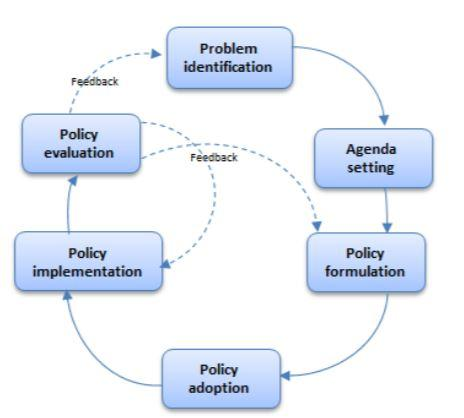
3.1 How planning connects to the policy cycle
Policy making determines public priorities, instruments and authorised choices. Planning helps translate these choices into objectives, resources, responsibilities and schedules; it also informs policy formulation. The two processes overlap, but their stage lists are not interchangeable.
Policy-cycle diagram:
Problem identification → Agenda setting → Policy formulation → Policy adoption → Policy implementation → Policy evaluation ↺ Feedback
| Policy stage | Meaning | Connection with planning |
|---|---|---|
| Problem identification | Establish the issue, causes, history, affected groups and gaps in existing measures | Needs assessment, evidence and baseline |
| Agenda setting | Secure government attention among competing demands | Prioritise needs and assess political and institutional support |
| Policy formulation | Develop and compare possible solutions | Set objectives, assess alternatives, costs, equity and feasibility |
| Policy adoption | The competent authority selects and authorises a policy | Obtain the approvals and resource commitments needed for the plan |
| Policy implementation | Put the authorised policy into practice | Assign budgets, staff, tasks, deadlines and delivery responsibilities |
| Policy evaluation | Assess intended and unintended results, equity and value for money | Compare results against objectives and revise the plan |
Feedback arrows:
- evaluation can lead back to problem identification if the diagnosis was wrong, formulation if the instrument needs redesign, or implementation if delivery arrangements need correction.
- Stages can overlap; this is a learning cycle, not a rigid one-way sequence.
Illustration — girls' schooling:
- identify unsafe travel as a barrier → prioritise attendance → compare transport support with other options → obtain appropriate approval → plan routes, funding and delivery → assess attendance, safety and cost → adjust the service or revisit the diagnosis.
CSS use:
- for a planning-process question, explain the ten planning steps above first; use this cycle to show their wider policy context.
- For a policy-making question, use the six stages here.
- Some texts combine identification with agenda setting and therefore show five stages.
Full definitions, models and policy-cycle explanation: Extra · III.0 What is Public Policy? The Policy Cycle and Social Policy.
4. Types of Planning (2023 Q8a)
4.1 By level (the four main types)
| Type | Level and horizon | Objective | Example |
|---|---|---|---|
| Strategic | Top level; long-term | Set direction and priorities | National vision, Uraan Pakistan |
| Tactical | Middle / departmental; medium-term | Turn strategy into departmental goals; coordinate units | Provincial education sector plan |
| Operational | Field level; short-term | Efficient day-to-day execution | Annual vaccination campaign schedule |
| Contingency | Any level; as needed | Resilience; "Plan B" for emergencies | Flood contingency plan of a PDMA |
4.2 Other classifications
- By time — short-term (annual plan), medium-term (5-year plan), long-term / perspective plan (10–25 years).
- By scope — national, sectoral (health, energy), regional / spatial.
- By nature — physical planning (roads, buildings) vs financial planning (resources).
- By control — imperative (command economy) vs indicative (market economy; government gives targets and incentives).
- By flexibility — fixed plans vs rolling plans (revised every year).
- Standing vs single-use plans — policies and procedures vs one-time projects.
5. Objectives / Importance of Planning
- Reduces uncertainty.
- Focuses scarce resources on priorities.
- Coordinates departments and levels of government.
- Provides standards for control and evaluation.
- Encourages innovation and foresight.
- Promotes balanced regional development.
6. Principles of Good Planning
- Clear, agreed objectives.
- Realism — matched to resources and capacity.
- Flexibility.
- Participation of stakeholders.
- Linkage with budget.
- Continuity and coordination.
- Built-in monitoring.
7. Approaches to Planning
- Top-down — centre sets goals; field implements. Works when goals are clear and uncontroversial (2026 MCQ).
- Bottom-up — local needs drive plans; better ownership; slower.
- Comprehensive (rational) model — study all options, choose the best.
- Incremental model (Lindblom, "Muddling Through", 1959) — small steps from the existing position; realistic but conservative.
- Mixed scanning (Etzioni, 1967) — broad scan plus detailed study of key areas.
8. 🇵🇰 Problems of Planning in Pakistan
- Short political horizons versus perspective planning — leadership changes can interrupt 15–25-year development priorities; use rolling targets and statutory, cross-party continuity for essential infrastructure and social services.
- Technocratic and local capacity gaps — specialist economists, engineers, evaluators and district planners may have limited influence or be in short supply; multidisciplinary appraisal and local consultation are essential.
- Donor-driven or tied financing — loan conditions and procurement constraints may misalign projects with locally assessed needs; compare full life-cycle costs and debt sustainability before approval.
- Provincial inequity and centralisation — top-down allocations may miss underserved districts; publish need-based distribution criteria and strengthen provincial and local ownership.
- Projects without robust feasibility — late site studies, land acquisition and cost revisions produce overruns; independent appraisal should precede commitments.
- Plans prepared but not funded (gap between PSDP size and approved portfolio).
- Political interference in project selection; constituency schemes.
- Weak data and feasibility studies.
- Poor coordination between federal and provincial plans.
- Cost and time overruns; throw-forward of incomplete projects.
- Weak monitoring and evaluation.
- Frequent policy reversals.
9. Critical Evaluation
- Planning is necessary, but in Pakistan the failure is mostly in linking plans to money and capacity, not in writing them.
- Exam verdict: A plan is only a promise until it has a budget, an owner and a monitor.
10. 📌 Past Paper Questions — CSS 2015–2026
Subjective questions
- 2023 · Q8(a) · 10 marks — Types and objectives of planning. → 2023 · Q8a · Types and objectives of planning (10 marks)
- Use: section 4.1 table + section 5.
MCQs from past papers
- 2026 · Q1(19) — In public-sector planning, top-down approaches are most effective when: (A) Policy goals are clear and objectives non-controversial (B) Street-level discretion is critical (C) Citizen participation is the primary driver (D) None of these → ✅ A. Top-down works when objectives are clear and agreed and the chain of command is manageable.
MCQ practice
- "The Science of Muddling Through" (1959) was written by: (A) Simon (B) Lindblom (C) Etzioni (D) None of these → ✅ B.
- Mixed scanning was proposed by: (A) Etzioni (B) Dror (C) Dye (D) None of these → ✅ A.
- A plan for emergencies is called: (A) Tactical (B) Operational (C) Contingency (D) None of these → ✅ C.
- In Pakistan, the project completion report is: (A) PC-I (B) PC-III (C) PC-IV (D) None of these → ✅ C.
11. 🎯 CSS Exam Perspective
11.1 How often it comes
- One short note (2023 Q8a) and one MCQ (2026). Planning also opens any Chapter III or IV answer.
11.2 Likely 2027 angles
- Steps of the planning process with Pakistan's PC forms.
- Rational vs incremental planning.
- Why plans fail in Pakistan.
11.3 Outline for a 20-mark question
- Q: Discuss the planning process in the public sector. Why does planning often fail in Pakistan?
- I. Introduction — definition
- II. Nature of planning
- III. Steps of the planning process (with PC-I to PC-V)
- IV. Types of planning (table)
- V. Approaches — rational, incremental, mixed scanning
- VI. Problems in Pakistan
- VII. Way forward
- VIII. Conclusion
11.4 How to score
- Use the four-type table.
- Show the PC-forms ladder as the Pakistan link.
11.5 Common mistakes
- Mixing tactical and operational planning.
- No example for contingency planning.
- Substituting the policy-cycle stages for the planning steps without explaining their relationship.
11.6 Active recall
- Ten steps of planning.
- Four types with objective and example.
- PC-I to PC-V.
🇵🇰 Pakistan examples — understand, apply and cite
How to use: choose the case that proves your point. “Exam sentence” is original model wording, not a quotation from an official. Facts are tied to the linked source and reporting period; practical applications are analytical explanations.
1. 2022 Post-Disaster Needs Assessment — diagnose before allocating
- Documented fact: The government-led assessment estimated damage, economic losses and reconstruction needs, with development-partner support. Source.
- Plain meaning / application: First identify what was destroyed and what rebuilding requires; then select priorities. Damage, lost income and rebuilding costs are different measures.
- Exam sentence: Pakistan's 2022 PDNA demonstrates how evidence about needs can guide recovery planning before projects are selected.
- Qualification: An estimated need is not an approved allocation or money already spent.
2. 4RF — short, medium and long-term planning
- Documented fact: The framework set planning horizons of one year, two to three years, and four to seven years. Source.
- Plain meaning / application: Urgent shelter, restoration of livelihoods and lasting resilience require different schedules. This is a concrete example for planning by time horizon.
- Exam sentence: Pakistan's 4RF distinguishes immediate recovery from medium- and longer-term reconstruction.
- Qualification: These are proposed horizons, not proof that deadlines were met.
3. Sindh Flood Emergency Housing Reconstruction — operational planning
- Documented fact: The December 2022 design provided housing grants for beneficiary-driven reconstruction meeting resilience standards. Source.
- Plain meaning / application: An illustrative work plan would specify household verification, grant release, technical advice and construction checks. These tasks turn a broad housing goal into delivery.
- Exam sentence: Sindh's flood-housing project illustrates how a recovery objective must become household-level tasks and technical standards.
- Qualification: The original housing target describes planned output, not completed houses.
4. Ehsaas Emergency Cash, 2020 — responding to a shock
- Documented fact: Emergency payments began in April 2020 for families affected by the COVID-19 lockdown. Source.
- Plain meaning / application: This is an implemented emergency response. A contingency plan, by contrast, is prepared in advance for a possible shock.
- Exam sentence: Ehsaas Emergency Cash illustrates rapid replanning during a crisis and the value of delivery systems that can be activated quickly.
- Qualification: Do not claim the specific pandemic response had been fully planned before COVID-19.