optional · CSS study notes
Theorist — Karl Marx (1818–1883)
📖 Introduction
- Who: Karl Marx (1818–1883), German philosopher/economist (his nationality is a common MCQ).
- The odd one out: of the seven theorists, Marx is the only one who supports Conflict Theory — Ibn Khaldun, Comte and Durkheim all support structural functionalism.
- Core claim: society is made of binary groups in constant conflict — one group earns/produces while the other enjoys at its expense.
- Allama Iqbal's tribute: Iqbal honoured Marx as a "man with a book, but not a prophet" (neest paighambar, walaikan dar baghal darad kitaab) — recognising the moral force of Das Kapital without treating it as revelation.
- Key works: The Holy Family · The Communist Manifesto · Das Kapital (Capital) · The German Ideology.
⭐ Significant features of his thought
⚔️ Conflict theory (his perspective)
- 🗣️ Plain language: society is not a smoothly-functioning body (as the functionalists say) but two groups permanently at war — the haves vs the have-nots.
- One group has more material, the other less; the clash between them is the engine of history.
- Example: today the rich get richer and the poor poorer — inflation deepening into stagflation.
🔄 Dialectical materialism
- 🗣️ Plain language: the changes in society come from material life — i.e. the economy, not from ideas alone (contra Hegel).
- History is a process of conflict between incompatible forces (those with more material vs those with less).
- Conflict produces a new stage of development — each clash pushes society to its next form.
- Example: the class structure (high/middle/low status) itself was created by the economic system.
🏛️ Materialistic interpretation of history (base & superstructure)
- 🗣️ Plain language: the economy is the base/foundation of society; every other institution (the superstructure) is built on top of it.
- History began when humans started producing their means of subsistence (before that, they only hunted and gathered).
- Production is a social, not isolated, phenomenon — it needs many people cooperating, which brings people together and raises integration.
- To understand all of history, study the development of material (the economy).
- Example: if the economic base is privatized (all resources privately owned), the whole superstructure — health, education, politics, religion — becomes privatized and fee-charging too.
🪜 The 6 stages of historical progression (classification)
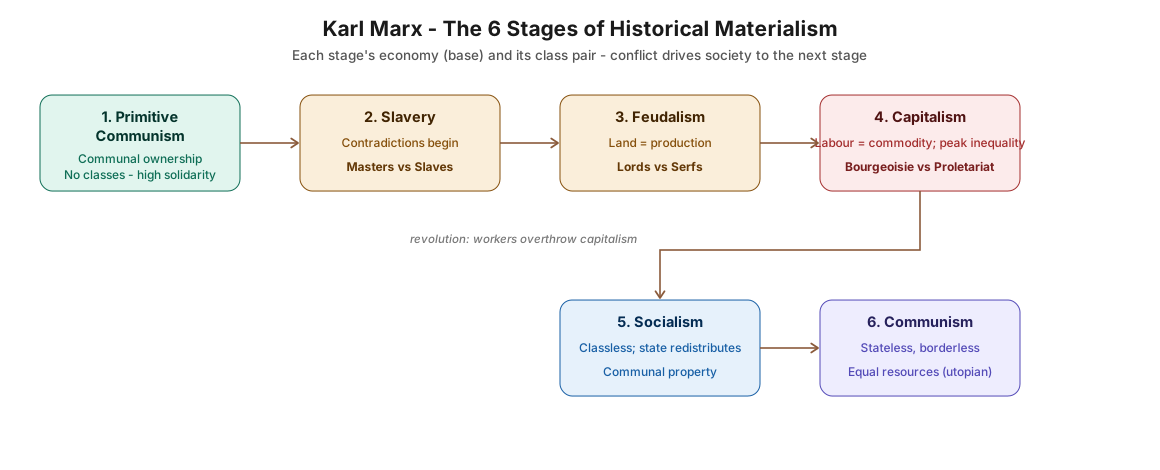
Marx's materialist history moves society through six stages — a favourite flowchart for exam papers (see the diagram below).
- Primitive communism.
- No contradictions; everyone worked together, high solidarity/integration.
- Means of production communally owned by the whole community.
- Slavery.
- Contradictions begin here — the first flaw in history.
- Class pair: masters vs slaves.
- Slaves were privately owned as a commodity and used as the mode of production, paid only the minimum revenue to stay alive.
- Feudalism.
- Begins with agriculture; means of production = privately-owned land.
- Class pair: feudal lords vs serfs.
- The lords decided how, when and whether the labourers were paid.
- Capitalism.
- Driven by industrialization; labour becomes the main commodity.
- Class pair: owners/CEOs (bourgeoisie) vs workers (proletariat).
- The surplus goes to the owners, workers get low wages → inequality at its peak.
- Socialism.
- A classless society — no high/middle/low classes.
- No private property; property is communally owned.
- A strong central state holds resources and redistributes them → no inequality.
- Communism.
- An ideal/utopian, borderless society — the world as one global village.
- No concept of a state; resources distributed equally to all.
😔 Alienation
- 🗣️ Plain language: under capitalism the worker who makes a product has no control over it — a sense of powerlessness, isolation and meaninglessness before institutions they cannot control and feel oppressed by.
- Example: a worker builds cars in a factory but can never afford or decide the fate of the car they make; the capitalist owner decides everything.
- Where it starts: in capitalism, once there is a ruling class and a working class.
- Leads to dehumanization — the worker becomes "just a commodity."
- The 4 manifestations of alienation:
- From the product — the worker has no control over the fate of what they make; the capitalist appropriates it.
- From the act of production — the worker can't decide how they work; the old satisfaction/gratification of free labour is gone.
- From human nature (species-being) — others use the product the worker made, but the worker cannot; free creative activity is lost.
- From other workers — production was once a social enterprise (cooperation); capitalism turns it into a market enterprise of isolated targets.
- Marx's solution: socialism — distribute everything equally so there is no rich/poor divide and alienation ends.
👥 Theory of social class
- 🗣️ Plain language: your class is set by your position in the economic organization — high surplus/accumulation = high class; very low = low class.
- Two-class model (relations of domination and exploitation):
- Bourgeoisie (ruling class) — the owners/bosses.
- Proletariat (working class) — those who do the work but whose surplus is taken.
- Example: factory owners enjoy the surplus while workers do the labour; factories pollute rivers with chemical waste — the working class drinks that contaminated tap water and ruins its health, while owners simply buy mineral water.
💰 Theory of labour & surplus value
- 🗣️ Plain language: labour is the greatest source of value — every product was once raw material that labour time turned into something valuable.
- Example: a house is just land, stones and dirt until labour and time turn it into a mansion; a car is raw material until labour builds it.
- The surplus-value illustration: raw material worth ₹50 + 4 hours of labour → a product worth ₹2,500.
- The worker should get ₹2,000 (the value their 4 hours created); only ~₹500 belongs to the owner.
- In reality the worker gets a fixed low wage and the surplus goes to the capitalist — the mechanism of exploitation.
- Workers have no choice but to sell their labour (they must survive / run their households).
☪️ Views on religion
- 🗣️ Plain language: Marx saw religion as a tool of exploitation that prevents social change — "the opium of the masses."
- It makes people habitual to injustice — "it was written in my fate/destiny" — so instead of fighting, they accept their lot.
- It relieves the pain caused by exploitation and oppression, making it bearable rather than solving it.
- It justifies the existing social order.
- Also (commodity fetishism): under capitalism, social relations between people appear as relations between things, hiding the human labour inside products.
📢 Famous slogan
- "Workers of the world, unite! You have nothing to lose but your chains."
- 🗣️ The guiding force/direction of many communist organizations.
- Marx's warning image: like a caged bird that forgets how to fly, or an elephant that stays tied by a small rope it could easily break — workers get used to their chains.
💬 Exact quotes (verbatim, for citation)
- "The philosophers have only interpreted the world, in various ways; the point, however, is to change it." — Theses on Feuerbach (1845), Thesis XI
- "The history of all hitherto existing society is the history of class struggles." — opening line, The Communist Manifesto (1848, with Engels)
- "Religion is the sigh of the oppressed creature, the heart of a heartless world, and the soul of soulless conditions. It is the opium of the people." — A Contribution to the Critique of Hegel's Philosophy of Right (1843) — note the full quote, not just "opium of the masses"
- "It is not the consciousness of men that determines their existence, but their social existence that determines their consciousness." — Preface, A Contribution to the Critique of Political Economy (1859) — the clearest one-line statement of historical materialism/base-superstructure
- "Workers of the world, unite! You have nothing to lose but your chains." — closing line, The Communist Manifesto (1848)
- "Capital is dead labour that, vampire-like, only lives by sucking living labour, and lives the more, the more labour it sucks." — Capital, Volume I (1867)
✍️ Model 20-mark answer — Evaluate Marx's contribution to alienation; discuss its types (CSS 2019, Q7)
- Intro: situate alienation as one of Marx's most influential and enduring sociological contributions — a diagnosis of the psychological/social harm capitalism inflicts on workers, distinct from his purely economic critique.
- Define alienation precisely: the estrangement of the worker from aspects of their own human existence and activity, produced by capitalist relations of production in which workers do not own or control the means of production and must sell their labour as a commodity.
- The four types/dimensions, each explained with an example:
- Alienation from the product of labour — the worker does not own or control what they produce; the product belongs to the capitalist and often feels like an alien, hostile object confronting its own creator (a garment worker who never sees or benefits from the finished branded product they sewed).
- Alienation from the process of labour — work becomes externally imposed, repetitive and meaningless rather than a creative expression of the worker's own will (assembly-line or highly routinized factory/call-centre work).
- Alienation from fellow workers — capitalist competition for scarce jobs and wages pits workers against each other rather than fostering solidarity, undermining collective human connection at work.
- Alienation from one's own human potential ("species-being") — Marx believed free, creative, self-directed productive activity is central to human nature; capitalism reduces work to a mere means of survival, alienating workers from this deeper human capacity for creative self-realization.
- Evaluate the contribution's significance: alienation shifted sociological analysis of capitalism beyond pure economics into workers' lived psychological and social experience — a foundation for later critical/humanist strands of sociology (and echoed later by the Frankfurt School's critique of the "culture industry" — see Additional Theorists page).
- Critical evaluation (for full marks): critics argue the concept is difficult to measure empirically, and some (functionalists) argue specialization/division of labour, while alienating in Marx's sense, also enables efficiency and rising living standards — present this tension rather than only endorsing Marx.
- Conclusion: alienation remains a powerful diagnostic lens for evaluating modern work — including gig-economy and highly routinized service work in contemporary Pakistan and globally.
✍️ Model 20-mark answer — Is Marx's capitalist perspective applicable to today's world? (CSS 2020, Q4)
Arguments FOR continued applicability:
- Global wealth/income inequality has widened in many economies — consistent with Marx's prediction of capital concentrating in fewer hands.
- The "gig economy" and precarious, non-unionized labour arrangements echo Marx's description of an insecure "reserve army of labour" that disciplines wages downward.
- Multinational corporations' influence over states and policy echoes Marx's account of economic power shaping political/legal "superstructure."
- Alienation remains visible in highly routinized digital-platform and service-sector work.
Arguments AGAINST/limitations:
- The sharp two-class (bourgeoisie/proletariat) model doesn't fully capture the complexity of modern class structure, which includes a large, differentiated middle/professional/managerial class (a common critique also raised against Marx by Weber's multi-dimensional stratification model).
- Welfare states, labour law, and union movements have significantly mitigated the raw exploitation Marx described in 19th-century industrial capitalism.
- Marx predicted capitalism's inevitable collapse and revolution, which has not materialized in advanced capitalist economies as originally theorized; capitalism has proven more adaptable than Marx anticipated.
- The rise of knowledge/service economies changes the nature of "production" and ownership in ways Marx's industrial-era framework does not fully anticipate.
Conclusion: Marx's diagnostic tools (class analysis, alienation, base/superstructure, the critique of exploitation) remain highly relevant analytically, even where his specific predictions (inevitable revolution, simple two-class polarization) have not been borne out — a balanced answer should affirm partial, not total, applicability.
✍️ Model 20-mark answer — Karl Marx's "Theory of Labor" (CSS 2015, Q4)
Question: Discuss in detail Karl Marx's "Theory of Labor."
- Introduction. For Marx, labour is not just an economic activity but the defining human capacity — the means through which humans transform nature, express creativity, and realize their "species-being" (essential human nature). His Theory of Labour explains both how human value is created and how capitalism distorts and exploits that process.
- Labour as the source of all value (labour theory of value). Marx (building on and revising the classical economists Smith and Ricardo) argued that the economic value of any commodity is determined by the amount of socially necessary labour time required to produce it — not by its usefulness or market price alone. Labour, in this sense, is the ultimate source of all wealth in society.
- Labour power as a commodity. Under capitalism, workers do not sell their labour directly — they sell their labour power (their capacity to work) to capitalists for a wage. This is the defining feature of a capitalist economy: labour power itself becomes a commodity, bought and sold on a market like any other good.
- Surplus value and exploitation. The wage a capitalist pays a worker is less than the full value the worker's labour actually creates during the working day. The difference — surplus value — is appropriated by the capitalist as profit. Marx considered this the precise mechanical basis of exploitation under capitalism: workers are paid for their labour power, not for the full value they produce.
- Division of labour. Marx analysed how the capitalist division of labour — breaking production into narrow, repetitive tasks — increases productivity and profit for the capitalist but simultaneously deskills and alienates the worker (linking directly to his theory of Alienation, above).
- Labour and alienation. Marx's Theory of Labour is inseparable from his theory of Alienation: because labour is humanity's most essential self-realizing activity, capitalism's distortion of labour (forced, externally controlled, product-alienated) is simultaneously an alienation from human nature itself — see the alienation model answer above for the four specific dimensions.
- Class conflict rooted in labour relations. Because surplus value is systematically extracted from the proletariat by the bourgeoisie, the two classes have objectively opposed interests over the control and reward of labour — the root of Marx's theory of class conflict and historical change.
- Pakistan application. Piece-rate garment and brick-kiln labour, bonded/haris agricultural labour, and low-wage gig work (ride-hailing, delivery platforms) in Pakistan's urban informal economy all illustrate labour-power-as-commodity and surplus-value extraction in a contemporary, non-Western setting — connecting directly to the Social Problems → Bonded Labour and Unemployment pages.
- Critical evaluation. Strength: the labour theory of value exposes exploitation obscured by market-price language ("fair wage," "free contract"). Weakness: mainstream economics has largely replaced the labour theory of value with marginal-utility/price theory; critics argue Marx underestimates how capital, technology and management also contribute to value creation, not labour alone.
- Conclusion. Marx's Theory of Labour reframes economic exchange as a site of power and exploitation rather than neutral market efficiency — a lens still used today to critically examine low-wage, informal and gig labour in economies like Pakistan's.
✍️ Model 20-mark answer — Alienation (Marx) and Anomie (Durkheim): a comparison (CSS 2017, Q5)
Question: Marx and Weber theorized that modern society alienated people. How do their approaches contrast, and how does their concept of alienation compare with Durkheim's concept of anomie?
- Introduction. Alienation and anomie are two of classical sociology's most important diagnoses of the psychological/social costs of modernity — both describe a form of disconnection or "wrongness" in modern social life, but they locate its cause very differently: Marx and Weber in structural/economic conditions, Durkheim in normlessness.
- Marx's alienation (recap). Estrangement of the worker from the product of labour, the process of labour, fellow workers, and their own human potential — caused specifically by capitalist relations of production and the private ownership of the means of production (see full alienation model answer above).
- Weber's version of alienation. Weber did not use "alienation" in Marx's exact economic sense, but his account of rationalization and the "iron cage" describes a parallel estrangement: modern bureaucratic, rule-bound organisation traps individuals in impersonal systems that strip away meaning, spontaneity and individual agency — alienation from meaning rather than only from the product of one's labour. Weber's cause is broader than Marx's — rationalization affects religion, law, and administration, not only the capitalist factory.
- Contrast Marx vs Weber. Marx: alienation is rooted in economic structure (class relations of production) and would in principle disappear with the abolition of private property/capitalism. Weber: alienation-like estrangement (the "iron cage") is rooted in rationalization itself, a broader civilizational trend that would persist even under socialism, since any large, rule-bound bureaucratic organisation (capitalist or socialist) produces it. Weber is therefore more pessimistic — he saw no escape route Marx believed revolution could provide.
- Durkheim's anomie. A state of normlessness — where a society's shared moral/normative regulation over individual desires and behaviour breaks down, typically during periods of rapid social change (industrialization, urbanization, economic crisis) when norms have not caught up with new social conditions. Durkheim linked anomie directly to a rise in "anomic suicide" (see Durkheim page).
- Compare alienation and anomie. Both describe a modern malaise/disconnection between the individual and society. But: alienation (Marx) is about estrangement from labour/production, rooted in economic structure and power; anomie (Durkheim) is about the breakdown of shared moral norms, rooted in insufficient social regulation, not exploitation. Alienation implies too much external control (capitalist domination); anomie implies too little normative control (moral deregulation) — in a sense, near-opposite mechanisms producing a similar symptom of individual distress.
- Pakistan application. Rapid urbanization and rural-urban migration can produce Durkheimian anomie (uprooted migrants lacking a stable normative community in the city — see Rural-Urban Migration page) and Marxian/Weberian alienation (informal-sector and gig workers experiencing both economic exploitation and bureaucratic/impersonal urban institutions) simultaneously — a well-rounded Pakistan example should show both operating together.
- Conclusion. Alienation and anomie are complementary rather than identical diagnoses of modernity's costs — one from too much structural/economic and bureaucratic control (Marx/Weber), the other from too little moral regulation (Durkheim) — together they give a fuller sociological picture of individual distress under rapid social change.
✍️ Model 20-mark answer — Capitalism vs Socialism: productivity, inequality, personal freedom (CSS 2017, Q6)
Question: What key characteristics distinguish capitalism from socialism? Compare these two systems in terms of productivity, economic inequality and personal freedom.
- Introduction. Capitalism and socialism represent the two major competing economic-organisational answers to the sociological question of how a society should own productive resources and distribute their output — Marx's own theory provides the classical socialist critique of capitalism.
- Defining characteristics — capitalism. Private ownership of the means of production; production and prices determined by a competitive market; profit motive drives economic activity; labour is a commodity bought and sold for wages; minimal (classical liberal) or regulated (welfare-state) state intervention.
- Defining characteristics — socialism. Collective/state (or, in some models, worker-cooperative) ownership of the means of production; production planned to meet social need rather than private profit; distribution aims to be more egalitarian ("to each according to their contribution/need"); the state or collective plays a central coordinating role in the economy.
- Compare on productivity. Capitalism's competitive profit incentive has historically driven high rates of innovation, efficiency and output growth (market signals allocate resources quickly). Centrally planned socialist economies (the historical Soviet/Eastern Bloc model) often suffered from weaker efficiency incentives and information problems in central planning, though market-socialist and mixed models complicate this simple contrast.
- Compare on economic inequality. Capitalism, left unregulated, tends toward significant inequality (Marx's own critique — concentration of capital, surplus-value extraction). Socialism explicitly prioritizes equality of outcome/distribution, generally achieving lower measured inequality, though often at some cost to individual incentive and productivity (the classic efficiency-equality trade-off).
- Compare on personal freedom. Capitalism is generally associated with greater individual economic freedom (choice of occupation, consumption, entrepreneurship) but Marx would counter this is "freedom" only in a formal/legal sense — the worker is still compelled to sell their labour to survive ("wage slavery"). Socialism (in centrally planned forms) has often constrained individual economic choice and, historically, political freedom as well, though democratic-socialist and Nordic welfare-state models show substantial personal/political freedom can coexist with strong redistribution.
- Middle ground — the mixed/welfare-state economy. Most contemporary economies (including Pakistan's) are mixed systems: private ownership and markets operate alongside state intervention (subsidies, public services, regulation, progressive taxation, state enterprises) — a practical synthesis rather than a pure form of either ideal type.
- Pakistan application. Pakistan's economy is predominantly capitalist/market-based with significant state intervention (public-sector enterprises, subsidies on utilities/fertilizer, Benazir Income Support Programme-style redistribution) — illustrating the mixed-economy middle ground rather than either pure model; land reform debates in Pakistan's history reflect the ongoing capitalism-vs-socialism tension over the ownership of productive assets (agricultural land).
- Critical evaluation. Neither pure model has proven fully sustainable in practice — pure market capitalism generates inequality/instability requiring correction, pure central-planning socialism has struggled with efficiency and political freedom; most successful modern economies blend elements of both.
- Conclusion. Capitalism and socialism differ fundamentally in ownership and distribution logic, producing a real productivity-vs-equality trade-off, with personal freedom cutting in complex, contested ways across both — most functioning states today, Pakistan included, manage a hybrid of the two rather than adopting either in pure form.
✅ Revision checklist
- Marx = the only conflict theorist of the 7; German; Iqbal's "man with a book, not a prophet" tribute
- Name his 4 key works
- Recite the 6 stages of history + the class pair for each (primitive communism → slavery → feudalism → capitalism → socialism → communism)
- State the base/superstructure relationship precisely (Q1(7) 2026)
- List all 4 dimensions of alienation with an example each
- Bourgeoisie vs. proletariat — one line each; the water-pollution example
- Explain surplus value using the ₹50 → ₹2,500 (4-hour) example
- Explain commodity fetishism with an example
- Marx's view of religion as a tool of exploitation (fate/destiny mechanism)
- Write the full alienation essay from memory with all 4 types and a critical evaluation
- List at least 3 arguments for and 3 against Marx's continued applicability today
- Explain the labour theory of value and labour-power-as-commodity in your own words
- Contrast Marx's alienation, Weber's rationalization/iron cage, and Durkheim's anomie in one paragraph each
- List capitalism vs socialism on productivity, inequality, and freedom — 2 points each