optional · CSS study notes
Theorist — Ibn-e-Khaldun (1332–1406)
📖 Introduction
- Who: Ibn-e-Khaldun (1332–1406), a North African Muslim historian and polymath.
- Key work: the Muqaddimah (Introduction to History) — a systematic, empirical analysis of society written centuries before Comte coined "sociology."
- Status: widely regarded as the Founder of Sociology / forerunner of the discipline.
- His science: Ilm al-Umran (علم العمران) — "the study of human social organization, civilization, and its growth and development."
🗂️ Key concepts at a glance (classification)
Quick-revision map of everything below — grouped by theme, with the Arabic term to write in the exam.
| Category | Concept (Arabic) | One-line meaning |
|---|---|---|
| Identity / discipline | Ilm al-Umran (علم العمران) | His named "science of civilization" — proto-sociology |
| Social organization | Badawah (بداوة) vs Hadarah (حضارة) | Rural/nomadic vs urban/settled life — his core distinction |
| Core mechanism | Asabiyyah (عصبية) | Group solidarity/cohesion — drives every rise and fall |
| Peak stage | Taraf (ترف) | Height of luxury that precedes decline |
| Transition | Ikhtilaf al-Ajyal | Generational difference of conditions (rural→urban) |
| Cyclical theory | 3 generations ≈ 120 years | Dynasty life-cycle: rise → peak → decline → fall |
| Dynasty stages | Zafar → Istibdad → Faragh → Qunu' → Israf | The 5 stages a dynasty passes through |
| Economic thought | Surplus value; consumption | Labour as source of value; consumption → social classes |
⭐ Significant features of his thought
- Asabiyyah (group solidarity/social cohesion) — his central concept: the strength of group bonds/solidarity determines a society's or dynasty's rise, cohesion and eventual decline.
- Cyclical theory of civilizations — dynasties/civilizations rise on strong tribal/group solidarity, peak, then decline as luxury and settled life weaken that solidarity over roughly three to four generations. (Q14 2024: this cyclical rise-and-fall pattern, tied to Asabiyyah, Umran and the stages of social development, is what "Muqaddimah" refers to.)
- Ilm al-Umran — Ibn-e-Khaldun's own term for his new "science of society/civilization" — effectively his own name for what would later be called sociology.
- Distinction between Bedouin (nomadic) and Hadara (urban/settled) societies — an early comparative/evolutionary framework for social organization.
- Emphasized empirical, causal analysis of historical/social events rather than mere chronicling — a methodological precursor to sociological science.
- Founder vs Father tip: Ibn-e-Khaldun is the Founder of Sociology; Auguste Comte is the Father of Sociology — keep the two labels distinct in MCQs.
🏜️ Badawah vs. Hadarah — rural and urban social organization (detailed)
Ibn-e-Khaldun was the first sociologist to systematically distinguish rural from urban life. Write the Arabic terms in the exam — examiners reward the correct terminology.
- Badawah (بداوة) = rural/nomadic/desert life · Hadarah (حضارة) = urban/settled life.
- On material & moral conditions he preferred Badawah — for its:
- simpler, organic living and cleaner environment;
- stronger morals, brotherhood and solidarity than the city.
🏡 Characteristics of Badawah (rural) organization
- Exists outside the centre — rural areas lie away from the city/capital; the internal social structure depends on distance from the centre — the farther out, the less it adopts from the centre and the more it lives its own separate life. Example: a remote village untouched by city customs vs. a peri-urban town that mimics the city.
- Simple structure — basic houses, small shops, agriculture; little to no labour specialization.
- High Asabiyyah — very strong group solidarity/cohesion (see below).
- No surplus — people accumulate only what they need, not for luxury; the surplus concept is near-absent.
🐫 Three types of Badawah community (by economy)
- Agriculturalists — those who labour on agricultural land.
- Cattle breeders (pastoralists) — herders of sheep, goats, cows, buffalo.
- Camel breeders — those who breed camels, living mostly in the desert.
🏙️ Hadarah (urban) organization
- Marked by modernization and luxury beyond necessity; stronger economic and social conditions; necessities already met; development is "complete."
- Development is continuous and reaches a peak-luxury stage Ibn-e-Khaldun calls Taraf (ترف) — the height of luxury that precedes decline. Example: the Mughal Empire's arc — vast expansion and power, then settling into peak luxury (taraf), then decline.
🔁 Theory of Transition (Badawah → Hadarah)
- 🗣️ Plain language: rural communities have the potential to transform themselves into urban ones over time. Example: a rural family that, as income rises, moves to a small car, then a bigger house, then a city lifestyle.
- The generational difference of conditions between Badawah and Hadarah is Ikhtilaf al-Ajyal (difference of generations) — conditions differ because the way of living differs.
- Transition depends on economic wellbeing — the stronger the economy/wealth, the greater the tendency and potential to transform toward a better condition.
- Two stages of transition:
- Develop beyond securing basic necessities.
- Strive for a higher stage of development — once necessities are secured, people work for surplus and greater economic value, gradually climbing to a higher stage.
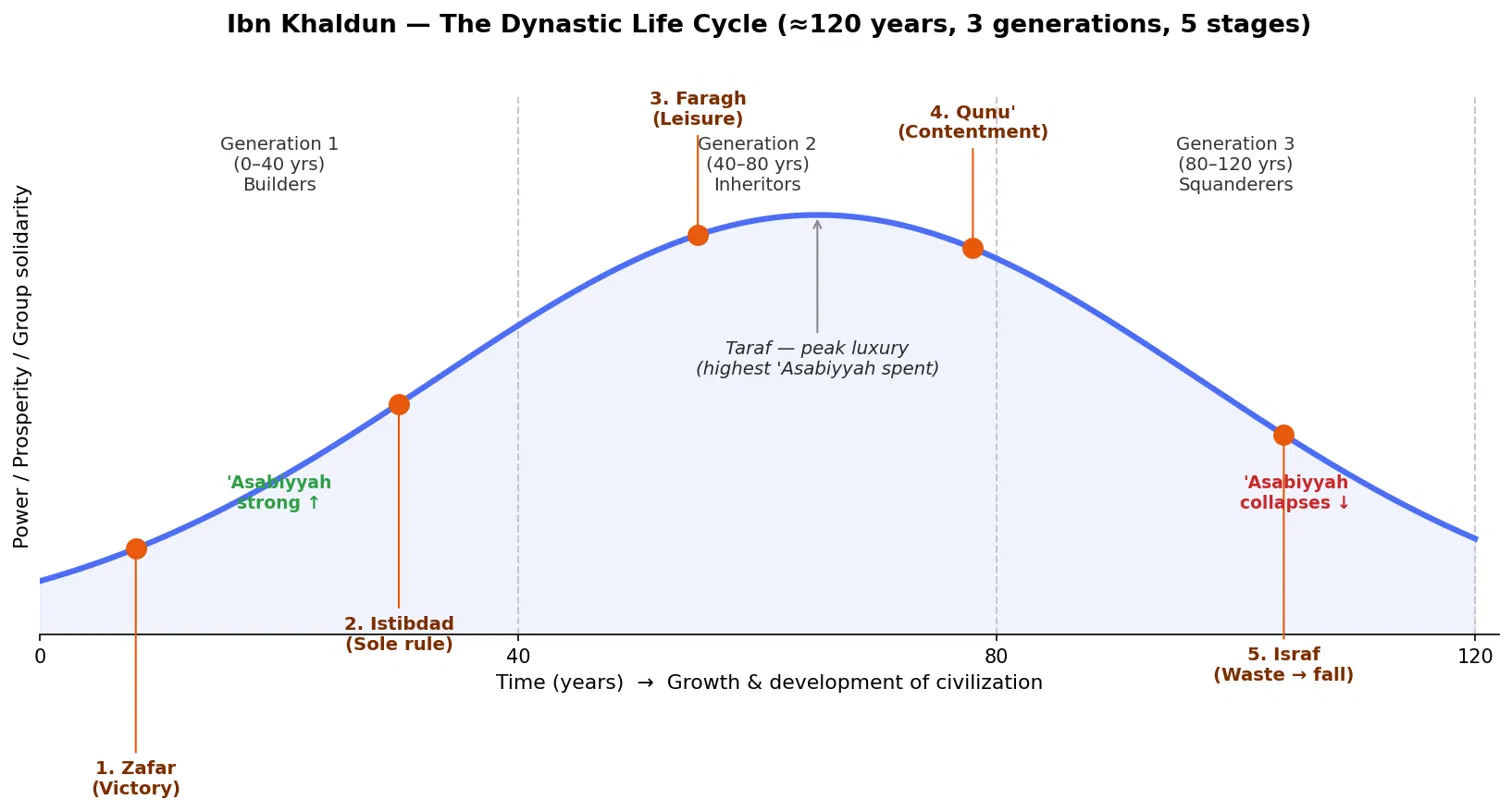
🔄 Cyclic theory of social/political change — the 120-year dynasty cycle (CSS 2020, Q20)
- 🗣️ Plain language: dynasties, like living organisms, are born, grow, peak, then decline and die — tied to the strengthening and then weakening of Asabiyyah. (Links to structural functionalism's organismic analogy: society, like a body, is made of parts/institutions that must each function for the whole to work.)
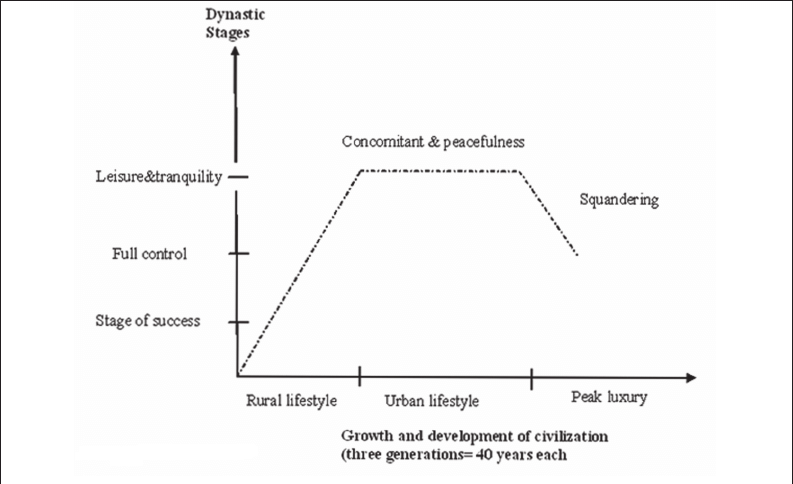
- A dynasty lasts no more than 3 generations.
- Each generation ≈ 40 years.
- So the full cycle ≈ 120 years.
- The arc: birth → growth → peak luxury → decline → fall/conquest by a fresher group.
- Every stage has its own social, economic and demographic characteristics, differing from the previous stage.
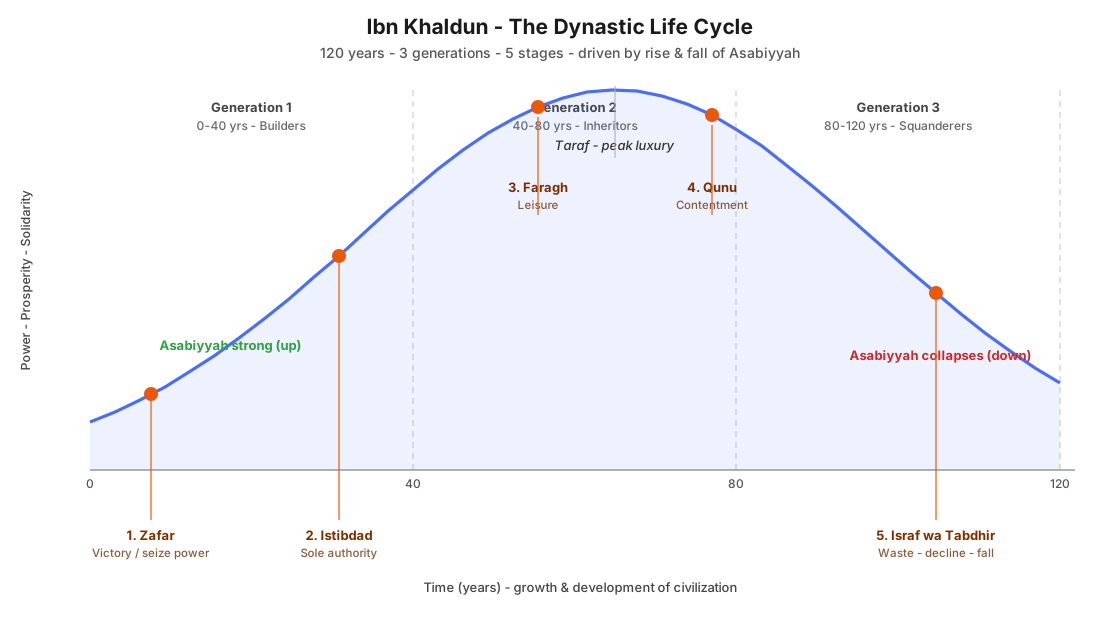
🪜 The 5 stages of a dynasty (within those 3 generations — memorize the names)
- Zafar (ظفر) — Success/Victory: the group succeeds and seizes power, still riding strong Asabiyyah.
- Istibdad (استبداد) — Concentration of authority: the ruler monopolizes power, sidelining even the kinsmen who helped him rise.
- Faragh / Faraghah (فراغ) — Leisure & tranquility: enjoying the fruits of power — prosperity, building, prestige; the state runs smoothly.
- Qunu' / Musalamah (قنوع) — Contentment & imitation: content and coasting, merely imitating predecessors with no new drive.
- Israf wa Tabdhir (إسراف وتبذير) — Extravagance & waste: resources (including human resources) are squandered; Asabiyyah collapses, the dynasty declines, and a fresher group conquers it — restarting the cycle.
💸 Consumption patterns & the origin of social classes
- 🗣️ Plain language: Ibn-e-Khaldun analysed the drivers behind consumption. Urban consumption is much higher than rural because city life demands status display — showing one's standard through possessions and social gatherings.
- As a community transitions rural → urban, consumption rises over time (small car → big car, small house → big house).
- The luxury lifestyle of the rich hardens into a custom, which creates differences, and those differences crystallize into social classes (upper, middle, lower/poverty).
⚖️ Theory of Surplus Value (labour theory of value)
- 🗣️ Plain language: all the value you receive is ultimately created by labour — labour is the source of value (an idea later echoed by Marx).
- Two types of labour:
- Primary labour — satisfies only basic necessities.
- Additional (surplus) labour — used when you want to generate profit/surplus, accumulate wealth, and move up social class.
⚖️ Evaluation (exam-ready)
- Strength: remarkably early systematic, cyclical, causally-grounded theory of social change — pre-dates Western sociology by ~500 years; often cited to argue sociology has non-Western intellectual roots too.
- Limitation: his cyclical model is deterministic and was developed from North African/Islamic dynastic history — limited direct applicability to modern industrial/post-industrial societies without adaptation.
💬 Exact quotes (verbatim, for citation)
- "Asabiyyah results only from (blood) relationship or something corresponding to it." — Ibn Khaldun, Al-Muqaddimah (1377, trans. Franz Rosenthal)
- "Dynasties have a natural life span like individuals... the life span of a dynasty does not as a rule extend beyond three generations." — Ibn Khaldun, Al-Muqaddimah (1377)
- "Man is 'political' by nature. That is, he cannot do without the social organization... for which the philosophers use the technical term 'ʿumran' [civilization]." — Ibn Khaldun, Al-Muqaddimah (1377) — his own coinage of ʿilm al-ʿumran, "the science of civilization/society"
- "At the beginning of the dynasty, taxation yields a large revenue from small assessments. At the end of the dynasty, taxation yields a small revenue from large assessments." — Ibn Khaldun, Al-Muqaddimah (1377) — the "Khaldun-Laffer" tax/revenue observation, occasionally cited in modern economics
- "The past resembles the future more than one drop of water resembles another." — Ibn Khaldun, Al-Muqaddimah (1377) — his statement of cyclical, pattern-based historical analysis
✍️ Model 20-mark answer — Comparing Asabiyyah and Durkheim's social solidarity: consonance and dissonance (CSS 2022, Q4)
- Intro: both concepts address the same core sociological question — what binds a group/society together and sustains its cohesion — but from very different historical and theoretical starting points, ~500 years apart.
- Define both precisely:
- Asabiyyah (Ibn-e-Khaldun) — group solidarity/tribal cohesion, strongest in nomadic/Bedouin groups, that drives a dynasty's rise to power; it naturally weakens over generations as the group settles into urban comfort and luxury, eventually causing decline — a cyclical, rise-and-fall dynamic.
- Social solidarity (Durkheim) — the cohesive bond holding any society together, taking two forms: mechanical solidarity (in simple, homogeneous societies, based on shared beliefs/similarity) and organic solidarity (in complex, industrial societies, based on interdependence through division of labour) — a linear, evolutionary progression from one form to the other, not cyclical.
- Consonance (points of agreement) — this is the core of a strong answer:
- Both treat social cohesion as the central variable explaining a society's strength and stability.
- Both link the type/degree of social bond to the type of social organization (Khaldun: nomadic/tribal vs. settled/urban; Durkheim: simple/homogeneous vs. complex/industrial).
- Both see cohesion as capable of weakening, with real social consequences (Khaldun: dynastic decline; Durkheim: anomie).
- Both were pioneers in treating social cohesion as an empirically analyzable, causally significant social force rather than a purely moral or philosophical abstraction.
- Dissonance (points of divergence):
- Direction of change: Khaldun's model is cyclical (rise, peak, inevitable decline, repeat); Durkheim's is linear/evolutionary (mechanical solidarity progressively gives way to organic solidarity as societies modernize, with no built-in inevitability of decline).
- Mechanism of weakening solidarity: for Khaldun, cohesion weakens through settled luxury and loss of tribal hardship/unity; for Durkheim, mechanical solidarity naturally transforms into organic solidarity through increasing division of labour — Durkheim does not treat this as decline but as a different, equally viable form of cohesion (though he separately warned that too rapid a transition could cause anomie).
- Scope: Khaldun's theory was built to explain the rise and fall of dynasties/political power specifically; Durkheim's was built to explain cohesion in any society, political power aside.
- Historical/cultural context: Khaldun theorized from Islamic/North African tribal-dynastic history; Durkheim theorized from the transition of Western Europe from traditional to industrial society.
- Conclusion: the two theories converge on treating solidarity/cohesion as sociology's central explanatory variable, but diverge sharply on whether social bonds evolve cyclically toward inevitable decline (Khaldun) or transform linearly into a new, equally functional form (Durkheim) — a genuinely productive East-meets-West comparison for a CSS answer.
✍️ Model 20-mark answer — Write a note in detail on Ibn-e-Khaldun's "Evolutionary Theory" (CSS 2015, Q8)
- Introduction. Ibn-e-Khaldun's evolutionary theory of society, laid out in the Muqaddimah, is a cyclical account of how civilizations/dynasties rise, mature and inevitably decline — built around the central mechanism of Asabiyyah (group solidarity).
- The starting point — Bedouin (nomadic) society. Nomadic/tribal groups, living under harsh conditions requiring mutual dependence for survival, develop very strong Asabiyyah — tight group solidarity, shared purpose, and military/political cohesion.
- Stage 1 — Rise to power. Strong Asabiyyah allows a nomadic/tribal group to conquer and establish political dominance over settled, urban (Hadara) populations, founding a new dynasty or state.
- Stage 2 — Consolidation and peak. The new ruling group settles into urban administration, building institutions, cities and cultural/economic achievements — civilization reaches its peak of power and prosperity, still drawing on (though gradually diluting) its original Asabiyyah.
- Stage 3 — Decline. Over roughly three to four generations, settled urban comfort, luxury and the loosening of tribal hardship progressively weaken Asabiyyah; the ruling group becomes softer, more focused on individual/status comforts than collective solidarity, and the state's cohesion and military/administrative strength erode.
- Stage 4 — Collapse and renewal. A weakened dynasty becomes vulnerable to conquest by a new, still-cohesive tribal/nomadic group with stronger Asabiyyah — and the entire cycle begins again with the new group.
- Key theoretical features (for full marks): the theory is cyclical, not linear-progressive (unlike Comte's or Spencer's evolutionary models); it treats group solidarity as the primary causal variable driving political/social strength; and it is explicitly empirical and causal, grounded in observed historical patterns of Islamic/North African dynastic history rather than speculative philosophy.
- Evaluation. Strength: a genuinely early, systematic, causally-argued theory of social change, remarkable for pre-dating Western sociology by roughly five centuries. Limitation: the model was built from a specific historical/tribal-dynastic context and does not map cleanly onto modern industrial or post-industrial societies without significant adaptation (see Evaluation section above).
- Conclusion. Ibn-e-Khaldun's evolutionary theory remains a foundational, non-Western contribution to the sociological study of social change — explaining not just that societies rise and fall, but proposing a specific, testable social mechanism (weakening group solidarity) for why they do.
✍️ Model 20-mark answer — Ibn-e-Khaldun, not Auguste Comte, is the true founder of Sociology? (CSS 2018, Q7)
- Introduction. The "founder of sociology" debate is a genuine, examinable historiographical question: Auguste Comte is conventionally credited as the founder because he coined the term "sociology" and formally proposed it as a positive science (1830s), but Ibn-e-Khaldun's Muqaddimah (1377) developed comparably systematic, empirical social analysis nearly 450 years earlier.
- The case FOR Ibn-e-Khaldun:
- He developed Ilm al-Umran ("science of civilization/society") — an explicit, named science of society, centuries before Comte's "sociology."
- His method was genuinely empirical and causal — analyzing historical patterns (Asabiyyah, the rise-decline cycle) rather than pure speculative philosophy, arguably closer to what we today call scientific sociology than much of Comte's own more abstract, stage-based philosophy of history.
- He addressed core sociological subject matter directly: social cohesion, social stratification (nomadic vs. settled), economic factors in social organization, and the causes of social/political change — the same core subject matter modern sociology studies.
- The case FOR Comte (the conventional position):
- Comte specifically coined the term "sociology" and explicitly proposed it as a new, independent positive science with its own method (positivism) — a deliberate disciplinary founding act that Ibn-e-Khaldun did not undertake in the same institutional sense.
- Comte's work directly and continuously influenced the subsequent, continuous institutional development of sociology as an academic discipline in 19th-century Europe (Durkheim, Spencer and others built explicitly on Comte's positivist programme) — an unbroken disciplinary lineage that Ibn-e-Khaldun's work, though historically prior, does not have in the same direct sense (his influence on Western sociology was largely retrospective/rediscovered).
- Discipline-founding is conventionally credited by whoever establishes the continuous, named, institutionalized field — not merely whoever first analyzed society systematically (by that broader standard, one could push the "founder" question back even further).
- A balanced synthesis (best answer structure): Ibn-e-Khaldun is most accurately described as a forerunner/precursor of sociology — someone who did genuinely proto-sociological, empirical, causal analysis of society well before it existed as a named discipline — while Comte remains the founder in the specific, conventional sense of naming the discipline and establishing its continuous institutional/intellectual lineage. Both descriptions can be true simultaneously without contradiction.
- Conclusion. Whether one argues "for" or "against" the question's provocative framing, the strongest CSS answer acknowledges Ibn-e-Khaldun's genuine intellectual priority in analyzing society scientifically, while defending Comte's distinct claim as the discipline's formal founder — a debate about the definition of "founding" a discipline, not about the quality or originality of either thinker's ideas.
✅ Revision checklist
- Define asabiyyah precisely
- Badawah vs Hadarah — write both Arabic terms + characteristics of Badawah + the 3 Badawah types
- Define Ilm al-Umran, Taraf, and Ikhtilaf al-Ajyal
- Explain the rise-peak-decline cycle in one paragraph
- Recite the 120-year / 3-generation cycle and all 5 dynasty stages (Zafar → Istibdad → Faragh → Qunu' → Israf wa Tabdhir)
- Explain how consumption patterns produce social classes, and the primary-vs-surplus labour distinction
- State why he's called Founder (not Father — that's Comte) of sociology
- Write the full Asabiyyah-vs-social-solidarity comparison with at least 3 consonance and 3 dissonance points
- Write the full 4-stage Evolutionary Theory answer (Bedouin origin → rise → peak → decline → renewal) from memory
- Argue both sides of the "Ibn-e-Khaldun vs Comte as founder" debate, then give a balanced synthesis conclusion