optional · CSS study notes
🎥 YouTube Lecture Notes — Criminal Justice System: Police & Prosecution
Source
From the CSS Criminology YouTube lecture series: Criminal Justice System of Pakistan — Playlist
Covers the Criminal Justice System's definition/objectives, the Police, and the Prosecution branch (Part 1 of 2 — see Judiciary, Prisons, Probation & Parole for Part 2).
Lecture Notes — Criminal Justice System: Definition, Police & Prosecution
1. Criminal Justice System (CJS) — Overview
- CJS is the set of agencies and processes established by government to control crime and impose penalties on those who violate laws.
- Core components/pillars: Police, Prosecution, Judiciary (Courts), Prisons/Corrections, and Probation & Parole services.
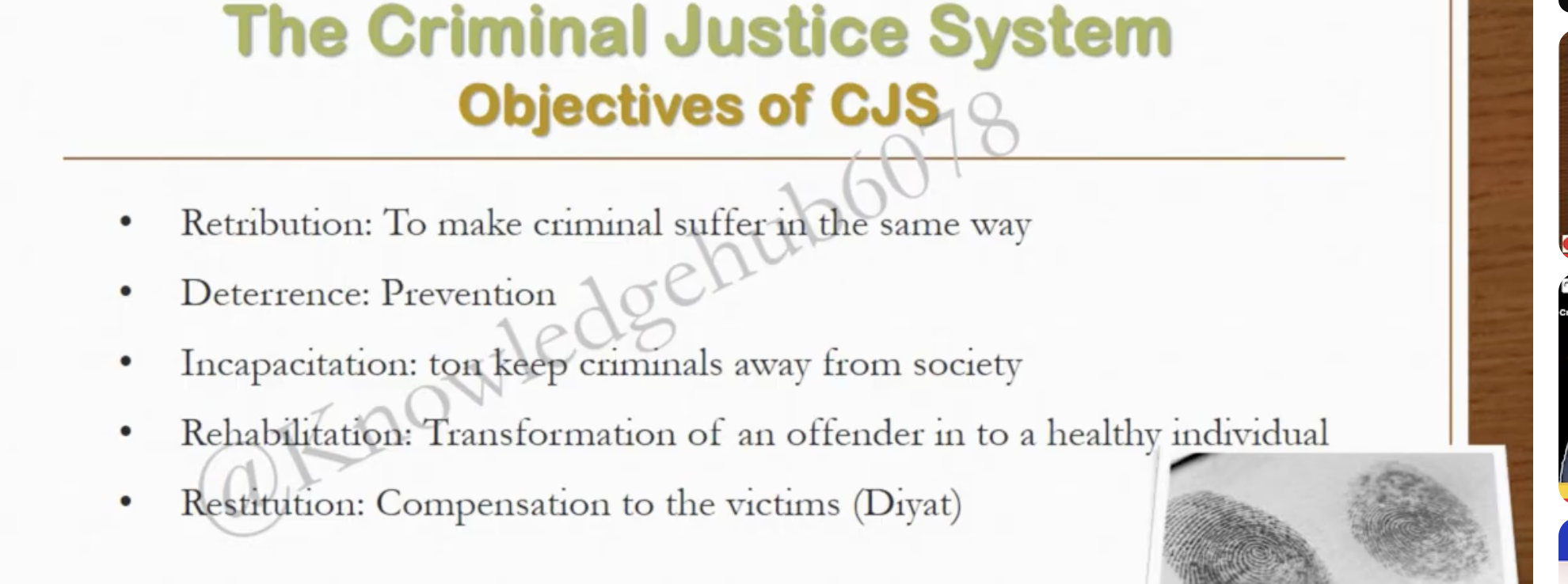
- Objectives of the CJS:
- To prevent crime and maintain law and order in society.
- To apprehend, investigate, and prosecute offenders.
- To ensure a fair trial and dispense justice impartially.
- To punish/reform offenders and reintegrate them into society.
- To protect the rights of victims, witnesses, and the accused.
- To deter potential offenders through effective enforcement of law.
2. Police — Role and Functions
- The Police is the first point of contact in the CJS; it is the investigative and law-enforcement arm.
- Core functions:
- Maintenance of public order and prevention of crime.
- Registration of FIR (First Information Report) on receiving a complaint.
- Investigation of criminal cases — collection of evidence, arrest of suspects, recording of statements.
- Production of the accused before a magistrate/court within the legally prescribed time.
- Protection of life and property of citizens.
- Traffic control and regulation.
- Assistance to prosecution in building the case for trial.
- Structure in Pakistan: organized provincially, headed by the Inspector General of Police (IGP) in each province, with a hierarchy down to Station House Officers (SHOs) at the police-station level.
3. Problems Facing the Police in Pakistan
- Political interference in postings, transfers, and investigations.
- Shortage of trained manpower and modern forensic/technological resources.
- Corruption and lack of accountability at various levels.
- Poor investigation quality — over-reliance on confessions rather than scientific evidence.
- Overburdened police stations, inadequate logistics (vehicles, equipment).
- Public mistrust due to alleged high-handedness, custodial abuse, and delays.
- Lack of specialized training in cyber crime, forensics, and modern investigation techniques.
4. Police Reforms & Use of Technology
- Proposed/ongoing reforms:
- Depoliticization of police through security of tenure for police officers.
- Separation of investigation wing from the watch-and-ward (law and order) wing.
- Establishment of specialized units (e.g., cyber crime wings, forensic units).
- Community policing initiatives to improve police-public relations.
- Capacity building and modern training academies.
- Role of technology:
- Use of forensic science laboratories for scientific evidence collection (DNA, fingerprinting, ballistics).
- Computerized crime record management and databases (criminal record systems).
- CCTV surveillance and safe-city projects in major urban centers.
- Use of geo-tagging and digital case-tracking systems to monitor investigation progress.
5. Prosecution — Role and Functions
- The Prosecution is the legal arm that represents the State in criminal proceedings.
- Core duties of Public Prosecutors:
- Scrutinize the police investigation/challan (charge sheet) before filing it in court.
- Advise the police on the legal sufficiency of evidence during investigation.
- Represent the State in court, present evidence, examine and cross-examine witnesses.
- Ensure that the trial proceeds in accordance with law and that justice is served — for the State as well as being fair to the accused.
- Decide whether to pursue, withdraw or compound (settle) a case within legal limits.
- In Pakistan, the Prosecution Service was established as a separate department from the police (Prosecution Service Acts in various provinces) to bring more professionalism and objectivity into case-building and trial conduct.
6. Problems Facing the Prosecution in Pakistan
- Shortage of trained prosecutors relative to caseload.
- Weak coordination/communication between police (investigators) and prosecutors.
- Poor quality of police investigation and evidence handed over to prosecution, weakening cases in court.
- Political and administrative interference.
- Low conviction rates due to weak evidence, witness hostility/intimidation, and delays.
- Lack of resources, forensic support and modern case-management tools.
7. Trial and Conviction Process (Overview)
- Sequence: FIR registration → Investigation → Submission of challan/charge sheet → Framing of charge by the court → Recording of prosecution evidence → Statement of the accused → Defense evidence → Arguments → Judgment (conviction/acquittal) → Sentencing (if convicted) → Right of appeal.
- Standard of proof in criminal trials: guilt must be proved beyond reasonable doubt.
- Key issues affecting trial and conviction:
- Case backlog and prolonged trials.
- Witnesses turning hostile due to fear, bribery or lack of protection.
- Weak scientific/forensic evidence base, over-reliance on eyewitness testimony.
- Low conviction rates in serious crimes, contributing to public perception of impunity.
Past Paper Angles
- "Discuss the structure and functions of the Police in Pakistan's Criminal Justice System. What reforms are needed to improve its efficiency?"
- "Examine the role of the Prosecution Service in ensuring successful convictions. What are the constraints it faces in Pakistan?"
- "Critically analyze the factors responsible for low conviction rates in Pakistan's criminal justice system."
Suggested Answer Outline
- Define the Criminal Justice System and its objectives.
- Discuss the Police's role, structure and key functions.
- Identify major problems (political interference, poor training, lack of forensic capacity).
- Discuss the Prosecution's role as the link between investigation and trial.
- Analyze problems in prosecution (coordination gaps, resource shortage).
- Conclude with reform recommendations: depoliticization, separation of investigation from law-and-order duties, technology adoption, capacity building, and better police–prosecution coordination.